Featured

The next 30 months

Last year one of my friends did 50 new things before she turned 50. This year another friend is having 50 brunches before she turns 50 (I’ve really enjoyed this challenge!) I realized last night that, God willing, in 30 months I will turn 60, a fact which is rather incomprehensible to me. I have been thinking about what 60 things I wanted to do before 60 and decided that I wanted to read the books that have been accumulating on my “to read” shelf. That’s when I did the math, realized I had 30 months and therefore would need to read roughly two extra books a month (besides murder mysteries and work related stuff) to make it. I decided to keep track of this project and to be able reflect on it I would blog about each book and on the process. So…the journey begins.

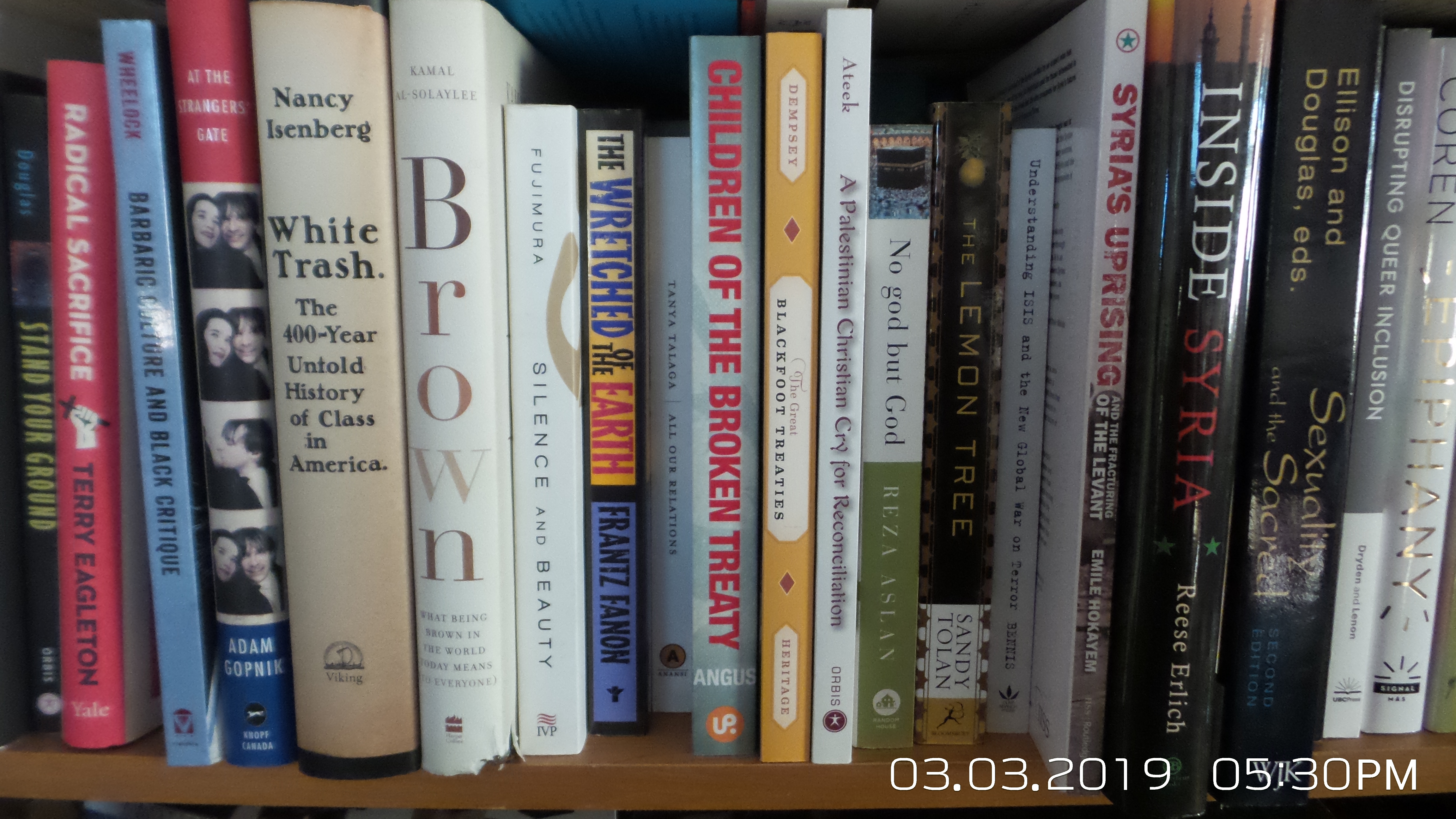
The books I have piling up cover a range of things that have interested me lately. No one will be surprised that there is theology and biblical stuff on my shelf. There are also a number of memoirs and some history, sociology, political theory, and books on refugee experience and Islam. There is also a good selection of poetry. I have some fiction I’ve been wanting to read and some studies of zombie literature. It is an eclectic collection. I’ve also been collecting many books on race and indigenous issues. In honour of Black History Month (I know, that was February but it seems wrong that it is the shortest month of the year) I will begin with James H. Cone’s memoir, Said I Wasn’t Gonna Tell Nobody.

More Light Reading

Well I’ve finished all of the Wesley Peterson mysteries in print – #28 will be released in August. They are mostly fun. The set up of a parallel historical mystery alongside the contemporary murder remains far fetched but actually works better in some of the later ones because the connections between the two are better made. I enjoy reading about the archaeology stuff in any case so it doesn’t really matter. There is no mention Covid or Brexit though so for all the connections to the past history of Britain there is very little sense of current events. I like the characters and I get caught up in the story quickly so happy I found them.

https://www.kateellis.co.uk/books/wesley-peterson

A friend put me on to another British mystery series, a police procedural set in Oxford. Simon Mason’s books are a very different experience from Ellis’s or even the Morse series. A Killing in November is the first and involves a murder at an Oxford College to which the wrong detective is dispatched. Ryan Wilkins is a working class, damaged, single dad, who grew up with an abusive father and who could ask easily ended up in prison as the police force. He’s sent instead of Ray Wilkins, a polished, public school educated, well dressed detective who is the ‘right-sort’ to investigate a crime at a college. The two end up being paired and chaos ensures but also some excellent detective work and a strange kind of friendship. In the second in the series, The Broken Afternoon, you begin to see that Ray is actually as messed up as Ryan. They aren’t easy reads but they are gripping. And the Oxford they reveal is not the idyllic ivy covered world Morse inhabits.

Further in the realm of mysteries I enjoyed the latest Jonathan Kellerman, Alex Delaware and Milo Sturgis mystery, The Ghost Orchid. This is #39 in the series and I continue to enjoy the friendship between the two men and accompanying them as they sort out the psychological ins and outs of the people connected to the crime. On a much sillier note, the most recent Janet Evanovich book, Dirty Thirty, is a hoot. The Stephanie Plum books are romps in which Stephanie never shows any emotional growth, all the characters are pretty one dimensional, and yet the chaos of her incompetence is pretty amusing. This is the poster child of the light read but I was recovering from covid and it was perfect for my foggy brain.

So that’s 21 of the next 65 reads accounted for. Next post, the non-mystery fiction.

Starting the next 65

My light reading this month has been to continue the Wesley Peterson mysteries set in Devon. So far I’ve read The Shining Skull, Flesh Tailor, and The Blood Pit. I’ve gotten a bit out of order because of what was available at the public library. The premise is that Wesley’s friend and archaeologist Neil Watson is always working on a dig that mirrors the murders Wesley is investigating. It’s a pretty ludicrous set up by book 13 but they are fun and I’m enjoying them. My more serious fiction right now is Abraham Verghese’s The Covenant of Water which I am savouring. I’m listening to the audio book read by the author and it is achingly beautiful and sad and moving. I’m about 60% through it now and already grieving that one day soon I will finish it. Then I expect I may have to read the paper copy so I can write out the lines I never want to forget. I loved his earlier novel Cutting for Stone and kept buying copies and giving them away. I think this will happen with this one too.

It’s been a while

I’ve gotten out of the habit of reading the books on my shelves instead of constantly buying new ones that pique my interest only to be too busy to read them. This year I did the Goodreads challenge and read 74 books most of which were murder mysteries read before bed. Work was intense and insomnia was my constant companion. But there were more challenging reads mixed in there. 

I read all the long form journalism I can by Rebecca Solnit, Masha Gessen, and Timothy Snyder and loved three of their books I read this year. I read the print version and listened to the audio version of Solnit’s Orwell’s Roses. It is a beautiful wedding of important ideas and gorgeous writing. Masha Gessen’s Surviving Autocracy is disturbingly relevant these days and Timothy Snyder released an audio version of his very important book On Tyranny with additional talks on the war in Ukraine. His course on the history of Ukraine found on the Yale Youtube site is very worth watching in its entirety as well.

Krista Tippet’s podcast On Being introduced me to the wonderful Irish poet and theologian Pádraig Ó Tuama and his new book Poetry Unbound based on his podcast of the same name is delightful. It is another book I have in print and audio format and when I can’t sleep his voice is balm for my soul. Ditto his lovely collection of autobiographical writings In the Shelter which carried me through a stressful time. In recent years I’ve discovered the challenge and the power and the beauty of the writing of James Baldwin and Eddie S. Glaude Jr’s book Begin Again is a wonderful exploration of his work. After reading David Graeber and David Wengrow’s The Dawn of Everything I am challenging myself to read the big pile I have of Graeber books sitting by my desk. 

For fiction the highlights of my ‘serious’ reading were Barbara Kingsolver’s new, much acclaimed, novel Demon Copperhead. I find myself thinking about it all the time. As healthcare in Alberta becomes more and more precarious and the future of oil and gas in question Kingsolver’s novel about the collapse of extraction industries and the developing opioid crisis felt very relevant. Ahmed Saadawi’s Frankenstein in Baghdad also haunts me. It’s a disturbing look at Iraq following the war and the ambiguities of virtue and vice. This novel contributed to some of my problems sleeping for a while. 

As someone who enjoys police procedurals, academic settings, and mysteries set in Britian I enjoyed discovering Elly Griffiths and Kate Ellis this year. I was sad to read the last Peter Robinson mystery and was very glad to read another of Thomas King’s Thumps DreadfulWater books. King is always a fun read and although it’s set across the border it always feels close to home and this time Stand Off even figures in the story.

I’m glad I kept track of the books I read this year. It didn’t feel like I had read much so it was reassuring to have a record of the reading that I did manage to do. I do have a very very big pile of books that wait to be read though so maybe this year I need to go back to my resolution of my original project to only read books from my shelves or the public library. Maybe it is time to start a 65 before 65 project. I’m 32 months away I think so replicating the same pace of 2 a month would do it. Onward forward!

https://www.goodreads.com/user_challenges/38375680

Books 89-95

The first book I read in 2021 was Thomas King’s Indians on Vacation and that got me going on a Thomas King tear. He is such a great writer. He’s funny and poignant and powerful and angry and unsettling and then funny again.

I only recently discovered that King has written a series of mysteries set south of the border in Blackfoot territory with a retired police officer who seems to bear a lot of similarities to King. Thumps DreadfulWater is a reluctant detective having settled in the community after the murder of his partner and her daughter. Mostly he’s trying to be a photographer but he keeps getting pulled back into detecting. The fifth of the series seems to wind it all up and I’m very afraid there will be no more in the series which will leave me very sad for I really loved these books.

DreadfulWater

The Red Power Murders

Cold Skies

A Matter of Malice

Obsidian

To top it off I listened to his Massey Lectures which were published as The Truth About Stories. Really worth listening to.

Book 86-88

Although I read a lot of murder mysteries I did read some non-mystery fiction. How to Pronounce Knife by Souvankham Thammavonga was really interesting. It is a collection of short stories about Laotian refugees/immigrants and I will never look at nail parlours the same again.

The Beekeeper of Aleppo by Christy Leferi was engrossing but the whole time I kept wondering about a novel written by a non-refugee from the perspective of refugees. Still it was engrossing and generated an interesting book group discussion.

A friend lent me Ken Follet’s new tome The Evening and the Morning and it weighed so much I had to buy it for my kindle because I couldn’t hold it up without my arthritis complaining. It is a heavy book in other ways too. Lots of corruption and plotting that struck too close to home for comfort. I didn’t like it nearly as much as his earlier books to which this one is the prequel. And I agree with one reviewer who said he needs to stop writing sex scenes from a woman’s point of view because he doesn’t get it.

Book 85

I found Homeland Elegies by Ayad Akhtar really hard to put down. I read afterwards that it is a mixed memoir/novel and now want to reread it to see what seems like what. It is a really gripping novel about the son of immigrants and his experience of being Muslim in America.

Books 82-84

I’ve read some good memoirs this year too. Steven Heighton’s Reaching Mithymna about his time volunteering on Lesbos with refugees was a good read. Eternity Martis’ book They Said This Would be Fun about her time as a student of colour at Western was a tough read but powerful. The one that has really stuck with me was Jillian Horton’s We Are All Perfectly Fine about burnout among physicians and the systemic problems with medical training and work life.

Books 71-81

Read a lot of mysteries lately too – all by authors I enjoy. I’m happy to say that Peter Robinson’s latest is back to his high standard after the previous dud.

Hid From Our Eyes – Julia Spencer-Fleming

Death in Sarajevo – Ausma Z Khan

Song of the Lion – Anne Hillerman

Not Dark Yet – Peter Robinson

The Safety Net – Andrea Camilleri

Serpentine – Jonathon Kellerman

Wild Fire – Ann Cleeves

A Private Cathedral – James Lee Burke

Land of Lost Friends – Alexander McCall Smith

The Long Call – Ann Cleeves

A Conspiracy of Bones – Kathy Reichs

Books 61-70

So over the winter I went on a Phryne Fisher tear. I’ve now read all the mysteries and they are mostly a lot of fun. There were one or two I found less interesting and one that was just weird. Mostly though they are great fun and have a lot to say about gender, class, and race. Also I love how Phryne creates family out of people who aren’t related to each other and who in some case have no family otherwise. She’s quite marvelous.

Death By Water

The Castlemaine Murders

Death Before Wicket

Death in the DarkMurder in Montparnasse

Queen of the Flowers

Unnatural Habits

Murder in the Dark

Murder on a Midsummer Night

Dead Man’s Chest

Book 60

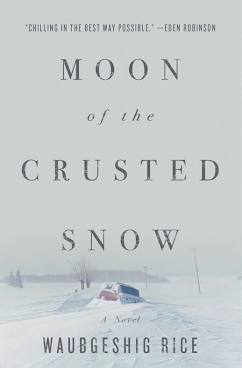
In the midst of a pandemic I have really avoided anything that is dystopic. Reality is dystopic enough. But somehow I picked up Waubgeshig Rice’s Moon of the Crusted Snow and it has haunted me since. Set in northern Ontario it is the story of a reserve where they wake up one morning without cell service, satellite service, power….any connection to people beyond the community. Young men who have been studying at college return to tell them that this has happened everywhere and that people are beginning to loot and pillage. Then a stranger shows up and asks for sanctuary.

Things unfold in an unsettling way and at the end you aren’t sure what you just read. I wasn’t sure if I wanted to know though…although I guess I do because I’m looking forward to reading the sequel. The part that really hit me hard though and that has haunted me was when the elder says the catastrophe that really devastated the community happened many years ago with first contact.

It is a disturbing thought to think that for indigenous people the present has been dystopic for a long time.