
Well I’ve been reading at a decent rate but not blogging obviously so time to start reflecting on what I’m reading.
A few years ago I read James Cone’s book The Cross and the Lynching Tree and it has haunted me ever since. It shows up in my Good Friday sermons and I think every church should play Billie Hollliday’s Strange Fruit that day. One Good Friday I played it as a part of my sermon and the impact was palpable. When I saw that Cone had written a memoir shortly before his death I picked it up wanting to know more about his theology.
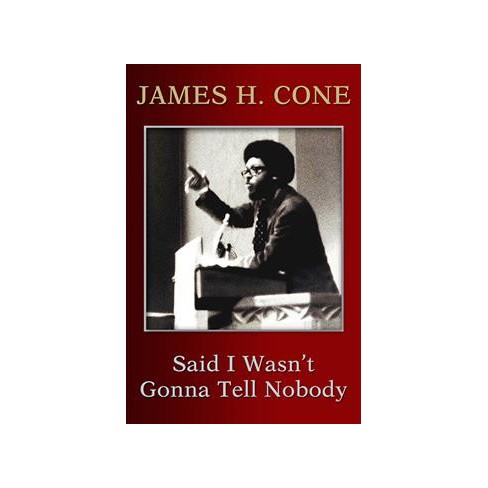
Said I Wasn’t Gonna Tell Nobody is an intellectual memoir – there is little in this book about his life outside of his reading, teaching, and writing so if you are hoping for a fuller sense of Cone’s life this won’t do it. But if you want to understand the contribution of one of the most important figures in black theology over the past 60 years this book is invaluable. Essentially Cone relates his own intellectual development by discussing each of his books in turn. He pays close attention to the books he read, the scholars he talked with, and the music he listened to. I think this was the first time that I really thought about the impact music might have on what I’m thinking and writing.
Cone has three significant conversational partners – Martin Luther King, Malcolm X, and James Baldwin. He integrates King’s concern for a proclamation of liberation with Malcolm X’s concern for blackness in his own black liberation theology. Baldwin was a constant literary inspiration:
“Nobody could preach love like Martin; nobody could talk black like Malcolm; and nobody could write with eloquence about love and blackness like Baldwin.” I’ve been stumbling on Baldwin’s work a lot lately and so he’s moved to the top of my 60-before-60 pile.
I was finishing this book just as the news broke of the mosque shootings in Christchurch and I was struck by how little things have changed in 60 years in terms of the “othering” of minorities and the constant threat of violence. Cone began his work with a sense of urgency in the midst of Jim Crow and the civil rights movement and he never lost that sense that this work was critical and urgent.
His own studies had begun with traditional European (white) theology and there is a significant moment early in his teaching career when he realizes that there is nothing in this theology that he thinks is urgent…nothing hangs on it. No doubt people (white theologians) would take issue with him but his observation that Niebuhr could write about justice for decades and never discuss Jim Crow or lynchings is pretty pointed. His observation that there is an underlying assumption that white, european theology is universal in a way that black, or feminist, or queer theology isn’t is I think very important. He was very clear that he was speaking out of a black context in response to black suffering: “We are all particular human beings, finite creatures, and we create our understanding of God out of our experience. Hopefully, our own experience points to the universal, but it is never identical with it. For when we mistake our own talk about God with ultimate reality, we turn it into ideology.”
I particularly enjoyed his chapter on his favourite of his books, The Cross and the Lynching Tree. It was interesting to read that he wrote this in part in response to feminist critique that theologies of the cross were oppressive to women because they encouraged women to submit to their own subjugation through a valorizing of suffering. Cone takes that critique seriously but develops a powerful theology of solidarity drawing on sources where Christ on the cross is seen as one who suffers with blacks as the first lynching victim: “It was their faith in Jesus’s cross, believing that if God was with Jesus, God must be with us, because we are also on the cross.” He argues that it was this vision of Christ’s solidarity in suffering that inspired a brutalized community with a vision of their own dignity and helped keep them sane through the darkness of slavery, segregation, and lynching.
My second read is the graphic book March about John Lewis’ life. I grew up hearing stories of MLK but it has only been in the last few years that I’ve learned more about the broader civil rights movement. There are three books telling the story of his life and work and I had the first on my pile and am almost finished it. I got the 2nd and 3rd out from the library so may need to read them quickly too. But more on that next time.

 60 Before 60