Books Nineteen, Twenty, Twenty-One, and Twenty-two

I love reading detective/mystery/spy type novels. I try to have one on the go all the time and at the end of my holidays I read a couple. The first two weeks of classes it has been harder to find extended time to read but I managed to read another.

David Baldacci’s The Fallen was a quick and engrossing read. It’s part of his memory man series about an FBI consultant who has suffered a traumatic brain injury and is blessed/cursed with an infallible memory. I like this character because he isn’t all hard-boiled and in control of things. And Baldacci’s pace is quick – no meandering for him. This one was particularly interesting because it was set near the Pennsylvania-Ohio border in a formerly booming mill town that is now struggling with both a devastated economy and the opioid crisis. I found it interesting to read while the debate (if you can call it that) over how to respond to our own crisis rages.

Louise Penny’s A Better Man was a much slower read but that’s because I never want them to end so I try to read them as slowly as possible. Last year when her husband died the publication of her annual Three Pines mystery was delayed for a few months but this year she was back on schedule, release the 4th Tuesday of August. I was at Chapters when they opened. Yes, I know I’m only supposed to count books I hadn’t just gone out to buy but this was bought with birthday money so it doesn’t count as a “bought” book. And yes I know that is a rationalization but I don’t care. To quote Jeff Goldblum “You can go a day without sex but try to go a day without a rationalization.” Extra points if you can name the movie.
I want to visit Three Pines. No I want to live in Three Pines. I would even endure Quebec winters to live in Three Pines. I want to be friends with Gamache and Clara and the whole village. I want to eat fresh baked croissants in the bistro and attend their little church. These are great mysteries but they are more than mysteries. These are books you want to live in, characters you want to know, conversations you want to be a part of. I can’t wait until the 4th Tuesday of August, 2020.

Ausma Zehanat Khan’s fifth book in her Esa Khattak and Rachel Getty series, A Deadly Divide, is very good. Also set in Quebec this book is about a mosque shooting. It was a tough read. It also deals with the political attempts to restrict religious symbols in public places and the increase in white supremacy activity. Her characters are complex and the plots intricate. I look forward to a sixth although I always feel like I’m battered and bruised by the end of them – even for murder mysteries they are dark.

Yesterday I finished Sara Paretsky’s Shell Game and I enjoyed it although I thought it could have moved quicker. This is her 22nd so I’ve been reading her for a long time. I like her characters, I like how she is allowing them to age. This one involves syrian refugees and the anti-immigrant climate of the US today. The story as it involved a murder and missing niece was great but there was a crucial sub-plot about stock manipulation and insurance fraud that was complicated. Since I only had time before bed to read this and I wasn’t drawing on a lot of brain power by the end of the day I mostly floated along the detailed explanations of off-shore banking and legal shenanigans.
Book Eighteen

I actually read this book last month on James Baldwin’s birthday. Since I watched the documentary I Am Not Your Negro it seems I see references to Baldwin everywhere. I’m not sure if there is a resurgence of interest in him or if it is just that now I’m paying attention. But I have a pile of his books now and started with The Fire Next Time.

It took me a long time to write this because I’ve been thinking a lot about the book and I didn’t want to dash something off. The first part of the book is a letter Baldwin wrote to his nephew about growing up in America as a person of colour. A few summers ago I read Ta-Nehisi Coates book Between the World and Me which is written as a letter to his son and I was disturbed reading Baldwin’s letter by how little things have changed since Baldwin wrote his letter in the early sixties. 

The second part of the book is an essay on race relations in the US and in particular Baldwin’s reflections on religious identity in the context of race relations. He details his own childhood in the church and his reasons for distancing himself it. But he also describes his meeting with Elijah Muhammad and his reasons for not joining the Nation of Islam either. The church failed to speak to the dire conditions of the neighbourhood Baldwin grew up in, promising instead eternal rewards. The Nation of Islam involved a rejection of the white community which Baldwin rejected.

Baldwin writes at length about the ways in which he thinks the circumstances of blacks and whites are tied together and argues that the emancipation of one is tied to the emancipation of the other. Life is ultimately tragic because one day we will all die and we will do anything to hide this fact from ourselves. Baldwin sees in white attitudes towards and treatment of blacks the projection of these fears on others in a futile attempt to see oneself as free from the fact of mortality.

I’ve been thinking a lot lately on the public hostility expressed in social media towards clients of our local Supervised Consumption Site as something of the same. If the racialized “other” is to blame for his or her problems, if they “deserve” punishment, if they are suffering the consequences of their own choices, then I am safe from the threat of the opioid crisis because I am protected by my race, my economic status, my virtue. To which Baldwin responds: whoever debases others is debasing himself. We are all in this together and if we are going to see a better world it is going to be by seeing our redemption as wrapped up in the redemption of all.

Book 17

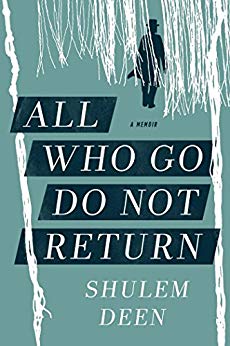
So I’m behind on blogging and I’m about to go out of order because I actually read this book yesterday. The joy of holidays is staying up half the night finishing a book because you can. Yesterday I read Shulem Deen’s All Who Go Do Not Return, a memoir of his life as a member of a particularly conservative Hasidic sect in New York. Deen’s community is very insular, he isn’t supposed to read secular books or newspapers, watch tv, or go to films. Schools, jobs, the neighbourhood…all part of the community. Marriages are arranged and the rebbe, the head of the community makes decisions for your life that are not negotiable. One member of the community decides not to invite the rebbe to a significant event and his car is trashed.

Deen begins to secretly read books and go onto the internet, becomes a blogger, begins to read historical criticism of the Bible and ends up not only leaving the community but losing his faith all together. His marriage fails and ultimately he ends up with next to no access to his children. It’s fascinating and horrifying and sad and I couldn’t put it down. In many ways it was like reading Tara Westover’s Educated which I also read in a day. Both of them give an glimpse into an insular religious culture and into the struggles when you’ve been denied a decent education of fitting in outside that culture.

Part of what made me sad was the way in which there was no room in the community to be a little different, to assert any independence, to deviate in anyway from the dictated pattern of life. This was replicated in the way in which there was no room to deviate intellectually either. To ask questions, to read books from outside the tradition, to engage with people outside the community, all these things are prohibited. When he loses his faith it seems inevitable.

When he talks about the questions he has, when he talks about the ideas he is encountering I kept thinking about how I knew about those ideas, I had read some of those same books…why didn’t they shake my faith in the same way. It strikes me that I was fortunate to find myself in a community (in the broadest sense) that allowed for these questions and that allowed me to find my own way of working through questions or not work through them without making me choose between them or the questions. What really struck me was the way in which participation in the community required great intellectual conformance as well as behavioural. I couldn’t do it. And neither could he. But it also struck me as he described his grief at what he had lost, his children being the greatest but not only loss, that those of us in looser communities also don’t experience the intensity of that kind of insular community.

There is a scene in the movie Witness, where Harrison Ford’s character, a police officer hiding from corrupt cops in an Amish community, is helping in a barn building. It is a delightful scene of a community helping out the newly married couple get set up. The next scene shows one of the elders telling the woman Ford has eyes for that people are beginning to talk and if she doesn’t stop it she will be shunned. In ten short minutes you see the price you pay for that kind of tight community.

All communities need to navigate the issue of conformity and diversity somehow and personally I’m not willing to give up ambiguity or my questions even to have a barn built in my backyard. It seems to me to be too high a price to pay.

Book Sixteen

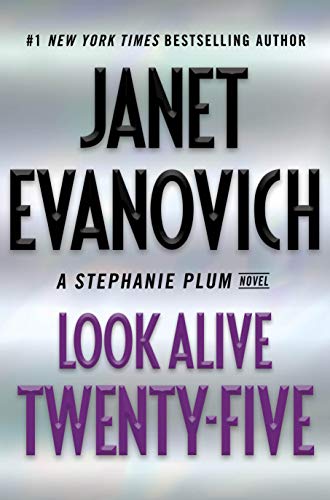
A few years ago a whole group of my friends were reading Janet Evanovich’s Stephanie Plum books. We’d pass them around and make jokes that required you had read the books. It was the most fun book club I’ve ever been in. The highlight was a supper of KFC and donuts with prizes for best costume and the trivia quiz winner.

Stephanie Plum is an incompetent bounty hunter in Trenton, NJ. She’s more likely to taser herself than the person she’s trying to apprehend and if it wasn’t for her cop boyfriend Morelli and her heart throb security expert Ranger she’d be in serious trouble. Unable to commit to Morelli she maintains a basic apartment with her hamster Rex with frequent sleep overs with Morelli and occasional chaste sleepovers with Ranger who always smells good. Her side kick is Lulu, a former prostitute who wears outrageous clothing, all tight, and spike heels but who is very good at sitting on people if Stephanie is able to bring them down. When they aren’t chasing bad guys they are eating lots of terrible junk food. Occasionally her grandma gets involved in her cases. Grandma Mazur’s favourite social event is checking out the good looking seniors at funeral home visitations. She is often packing and is prone to opening caskets should it not already be open.

These are not profound books. They follow a formula and over 25 books I don’t think we can really talk about character development. But they make me laugh. Book 16 is Look Alive Twenty Five and it did not let me down. I laughed out loud.

Book Fifteen

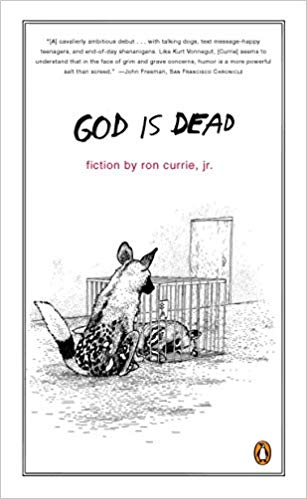
So in my post on book 14 I quoted a poem by Ron Currie, Jr. In another place in the poem he talks about a book he wrote in which he writes about a Sudanese refugee camp. I check out the book, it’s call God is Dead, and I’m intrigued. The public library has it, I start reading it at about seven last night and I read until I finish it.

It reads like a bunch of interconnected short stories all responding to the premise of the first chapter, that God was incarnate in a refugee girl who is killed in a camp and whose body is then eaten by dogs. People realize that she was God when the dogs gain human awareness and are able to communicate telepathically with humans. One of the dogs relates that story in a later chapter.

It is such a strange book that I really wish I had someone else who had read it so I could talk about it with them. In part the book is saying things about the problem of evil – God repents for not preventing suffering and the description of suffering in the refugee camp is tough reading. In fact, there are many places where this is tough reading. Murder, suicide, war, abused dogs. I need to think about it more. Or convince a friend to read it so we can talk.

Book fourteen

In the last 25 years I’ve had 3 bouts with cellulitis. All three necessitated long stints of IV antibiotics which until recently meant day time treatments M-F in outpatients and evening and weekends in Emerg. There would come a point when I wasn’t feeling so terrible anymore and I would start to find the experience fascinating. I know, weird eh? I am still friends with some other patients and with some of the nurses I met during the last two runs. Before renovations which made the ER all white and shiny and much more private it was an amazing place to watch human interactions. I used to know who was on triage when I walked in just from the anxiety levels in the waiting room. There were a couple of nurses who were incredibly skilled at calming people down and even making us laugh in the midst of our suffering. I decided that I should have gone into medical sociology when I did my uni studies as there really is nothing more interesting to study. I could have done my field work in ERs!

One of the things I grew to love about going to the hospital three times a day was all the time I had to read. My fascination with the place also lead to my reading lots of medical memoirs and it is a big field. Brian Goldman’s The Night Shift, Tilda Shalof’s The Making of a Nurse, and Victoria Sweet’s God’s Hotel are my three favourites in that genre. My 14th book in this project is James Maskalyk’s Life on the Ground Floor: Letters from the edge of emergency medicine and it will go on the shelf next to others as a great read. Maskalyk alternates between working in Toronto and Ethiopia and weaves together stories from both with stories of his grandfather who lives in northern Alberta. It’s a very moving book that seemed to me to be a meditation as much on dying as on healing.

I’ve been thinking about this book since I finished it. One of the things I find fascinating about it is that while there are obviously big differences between emergency medicine in Toronto and Addis Ababa what struck me was the similarities. In both situations it is Maskalyk’s connection to patients that is front and centre. And in particular, it is his ability to remain present to his patients even in the presence of suffering and their dying that moved me. He describes the signs of burn out when indifference and anger become the attitude of staff towards patients. It struck me how this parallels in some ways the experience of ministry when clergy begin to feel manipulated, or criticized, or taken for granted and begin to resent the people they are called to serve. But while Maskalyk may say, it is time then to quit, he’s actually very understanding of the struggles to stay healthy in medicine (and I suspect “helping” professionals generally). Certainly there are unique aspects to the kind of intensity he experiences in his work and particular issues in working shift work (he talks about the dangers of self-medication to get to sleep and to wake up) but there is a lot of wisdom in his observations for anyone struggling with compassion fatigue or secondary trauma.

At one point Maskalyk talks about how in addition to the worries docs start taking the numbness home too. He says that joy starts to seem like it is for fools because in the end all of us will die. This made me think of Caleb Wilde’s comments about being risk averse and overly protective of children because of the awareness of how badly things can go. A friend of mine, a funeral director, asked me once, when I was really cautious about walking down a dock to get into a boat, if I had always been this scared of the water. No I said, I grew up on boats and around water. I’d become this way after 20 years of doing funerals. Working with post-secondary students too many of the services I’ve done have followed tragic deaths. It is easy to become obsessed with the fragility of human life and to begin to resent people who seem blissfully unaware of how quickly their lives can change.

There is a line in the film version of Shadowlands in which a student says to C.S.Lewis, something to the effect of “I read to know I’m not alone.” I felt often reading this book, despite living and working in very different circumstances, a sense of recognition. In an incredible poem entitled “fuck you ee cummings”, Ron Currie writes:

when you’re a writer people sometimes ask
why you decided to be a writer
insofar as there’s any answer
the thing i’ve settled on is that
writing is an act of faith
the faith that you and i love the same things
fear the same things
grieve the same things
no matter that i am a man and you are a woman
or that i am white and you are latino
or that i am american and you are afghani 
faith, in short, that love and fear and grief are the same thing everywhere
and the rest is just details
and that if i write about the things i love and fear and grieve,
you will see yourself in me
and vice versa
and having looked in the mirror
and seen ourselves rendered strange yet recognizable
we will be less lonely and afraid and angry
and less inclined to want to kill each other
and less likely to dismiss each other’s suffering
maybe.

Maskalyk is a really good writer.

Book thirteen

Another audio book. Another Andrea Camilleri. This time it was August Heat. The subject matter was really disturbing and Camilleri’s way of writing about women is often unpleasant. Women are victims or manipulative and deceitful. Ugh. Will take a break from him for a while.

Book 12

A few days ago Macleans released an article on the working class in Canada focussing on the work of Wolfgang Lehmann, a sociology professor at Western. Lehmann studies the experience of working class students in university and this was the focus of the article. https://www.macleans.ca/society/what-does-it-mean-to-be-working-class-in-canada/ It is a fascinating article and echoed many of the things a friend has said to me about going to university after growing up in a mill town.

In each of the last three summers I’ve read a memoir by someone who grew up poor and disadvantaged and yet achieved stellar educations. Two summers ago it was J. D. Vance’s Hillbilly Elegy. Last summer it was Tara Westover’s Educated. Vance’s book details how he grew up in poverty in Ohio but after serving in the marines was able to attend Yale Law school. He describes the obstacles that stood in his way, both in getting to university and to fitting in once he got there. It was a bestseller but was also criticized by some for underplaying the systemic barriers at play for many poor students, particularly those of colour. Westover recounts her childhood in a fundamentalist mormon family where the children didn’t go to school or access medical treatment. But she loved learning and is able through a remarkable effort to teach herself enough to get admitted to BYU. Ultimately she is able to study in Cambridge. This is also a gripping book and became a bestseller. Both writers offer insight into the challenges they faced of not “belonging” at university but also becoming alienated from their own families and communities because they have gone.

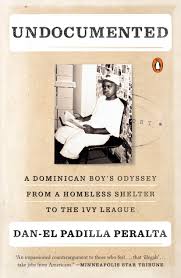
After reading a review this winter I picked up another memoir in this vein, Undocumented, by Dan-el Padilla Peralta. Peralta, who now is a classics professor at Princeton, came from the Dominican Republic as a boy with his parents to live in New York. His father returned after the birth of his brother but his mother decided to stay with her two sons although only her youngest had papers once her visa expired. Undocumented is Peralta’s story of growing up in living in constant fear that their lack of papers would be discovered and they would be deported. He loved books and learning and was fortunate to meet people who opened doors for him – a private school education that led to Princeton and then Oxford. Ultimately he was given papers and allowed to return to the US where he did a doctorate at Stanford. In many ways it is an exceptional story and he addresses that clearly in the last chapter. He now advocates for immigration reform and for other undocumented students and he knows his story is not typical. He attributes much of it to luck and refuses to see his own story as a “rags to riches” story of personal accomplishment. The system is broken and has gotten even worse since 2015 when the book was published.

I remember reading John Osborn’s classic account of Harvard law school, Paper Chase, and being inspired to study study study. Peralta’s book inspired in me some of that same love of study and desire to immerse myself in reading. It is difficult to explain to those who see reading as a task or chore how it can be a delight and magical as it clearly is for him. Reading opens up a world to Peralta as they are living in a shelter. It is fascinating to read how he discovers classics and to read his reflections on why it is largely a white discipline.

A big part of what is both painful and engrossing about the book though is his account of what it is like living in multiple worlds and not feeling at home in any. The energy that goes into keeping secret his status is exhausting. And then there is the discussion over what it means to be black on a predominately white campus and whether he has an obligation to speak out about his immigration status. It’s a powerful read.

One last thought: Peralta is very clear that he was fortunate to receive support and love from teachers and others along the way. His story is a great example of how people can make a huge difference in the life of a child by showing up, by challenging them, and by loving them.

Book Eleven

I started listening to podcasts with funeral director Caleb Wilde (one of my favourite names ever) in the last couple of years and then started reading his blog Confessions of a Funeral Director https://www.calebwilde.com/. I’ve had a fascination with the funeral business for a long time and there are many books about it. Probably the most famous is Jessica Mitford’s The American Way of Death which created a real stir by revealing much of the business side of the business. My favourite is probably Tom Jokinen’s Curtains: Adventures of an Undertaker in Training. Jokinen worked for the CBC in Winnipeg and took a leave to train in a very well known Winnipeg funeral home. I especially loved it because I knew the places he was describing and some of the clergy he talks about are friends.

Clergy spend a lot of time thinking about funerals. They are a big part of what we do. And it may surprise people to know this but generally they are part of the work that clergy are really glad to do. I don’t know how many times a colleague has said, I’d rather do a funeral than a wedding any day. I was at a clergy retreat in May and at one meal there were half a dozen clergy and one layperson. She was shocked when someone said this and then there was a chorus of agreement. Note, no one said they didn’t like doing weddings, they just preferred funerals.

It is a really difficult part of ministry. But it is also holy time, holy space. I often find it really difficult to explain what it is like to be with someone when they die, or to be with a family as we plan the funeral. But as I read Wilde’s book Confessions of a Funeral Director: How the Business of Death Saved My Life I kept thinking “yes,” that’s it. Wilde is part of a family funeral home in a town where his family has known and buried everyone for generations. His book is a really honest expression of his own struggles of faith and the journey he made towards what he calls a death positive narrative.

There is much I like about Wilde’s theology like his focus on God’s solidarity with us in our suffering. He talks about coming to terms with our mortality as an essential feature of our humanity in ways I think are really important. I wondered if he has read Richard Beck’s book The Slavery of Death in which Beck teases out the implications of the Eastern Orthodox reading of the fall in which death leads to sin rather than the western reading in which sin leads to death.

Mostly though what I loved about this book was the way in which he would describe the holy moments when in the midst of sorrow there was community. In one account of a scene where there was wailing and tears and he was conscious of being on the clock he relates how he stilled himself and allowed himself to be present to the sorrow: “With renewed eyes, I saw a rare moment when heaven was born. I saw a community honestly express the horribleness of death. In a rare moment, I saw how death and dying creates community by allowing us to touch one another’s humanity.”

The last chapter of the book is a list of ten things Wilde believes about the spirituality of death. One of them resonated deeply with me: “Death cannot be tamed. Death can either break us open or it can break us apart. Those who are broken open find more room for compassion, understanding, forgiveness, and the Other. Let death break you open.” When my dad died one of my best friends said to me, “our hearts are broken but they are also broken open.” Those are words to live and die by.

Books nine and ten

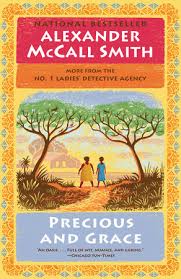
A few years ago I had a bad bout of pneumonia which put me in the hospital for four days. For weeks afterwards I had a hard time reading anything that required concentration. A friend dropped me off a bag of the No. 1 Ladies’ Detective Agency books and those I could manage. Alexander McCall Smith has written this series and a couple of others set in Scotland but I’ve never been able to get into those. But this series, set in Botswana and focusing on Mma Ramotswe, a traditionally built woman, and her co-director Mma Makutsi are quite lovely. Lately feeling like my soul was aching from endless terrible news of family separations on the American border and indigenous children with boils all over their bodies caused by contaminated water I decided I needed something gentle so I read #17 in the series, Precious and Grace.

These books are not gripping murder mysteries and there is no complicated discussion of justice or redemption. Generally people bring more quotidian mysteries to the #1 Ladies’ Detective agency for their solving. And there are no car chases and rarely police involved. Mostly they are slow meandering novels about the relationships between the two women at the heart of the agency, their husbands and children, and the others who are connected to them. Each novel involves at least one visit by Mma Ramotswe to her friend Mma Potokwane at her orphanage where they always share tea and fruit cake. There are comments about the new technology in cars (Mma Ramotswe’s husband owns a garage located next to the agency) but there are few clues about when the novels are set. Nelson Mandela is frequently mentioned as a hero but I don’t remember that it is every said that he is “late” so that doesn’t help date them. There are frequent discussions of how terrible it is that things are not the way they used to be but no explicit discussion of AIDS or political conflict. Drought is a constant problem but there is nothing said either about climate change.

Now that my head is less foggy I find myself wondering what people in Botswana think of these books or what someone discussing colonization or race would say about them. But mostly I just enjoy spending time with these people. They are kind and gentle and good hearted. I don’t even really worry about paying too much attention to who did what. It is enough to sit on the veranda with them and enjoy the quiet of an evening. In this book Mma Ramotswe and her husband have a conversation about whether dogs have souls (they do) and then she asks him whether our souls grow as we get older. “Yes,” he said. “Our souls get wider. They grow like the branches of a tree–growing outwards. And more birds come and make their homes in these branches. And sing a bit more.” This is theology I can live with.

Book ten was another audio book by Andrea Camilleri, Game of Mirrors. It was okay.