So a funny thing happened on the way to 60. For reasons I don’t understand I didn’t want to get to book 60 so far ahead of my birthday. And a new bookstore opened in town and I completely abandoned the whole, don’t buy books, read what you have premise. When the bookstore owner tells you that she is worried she’s enabling unhealthy buying you know you have really abandoned the premise.
Now the truth is that I have read lots that I got out from the library and some that I bought with gift cards (two of my gross rationalizations from earlier) and I’ve read a couple from my shelves. So I’ve chosen two books that meet the criteria for books 59 and 60 and then will post the list of everything else I’ve read. And since I’m now on holidays I expect to be reading a lot more in the next few weeks. Joy!
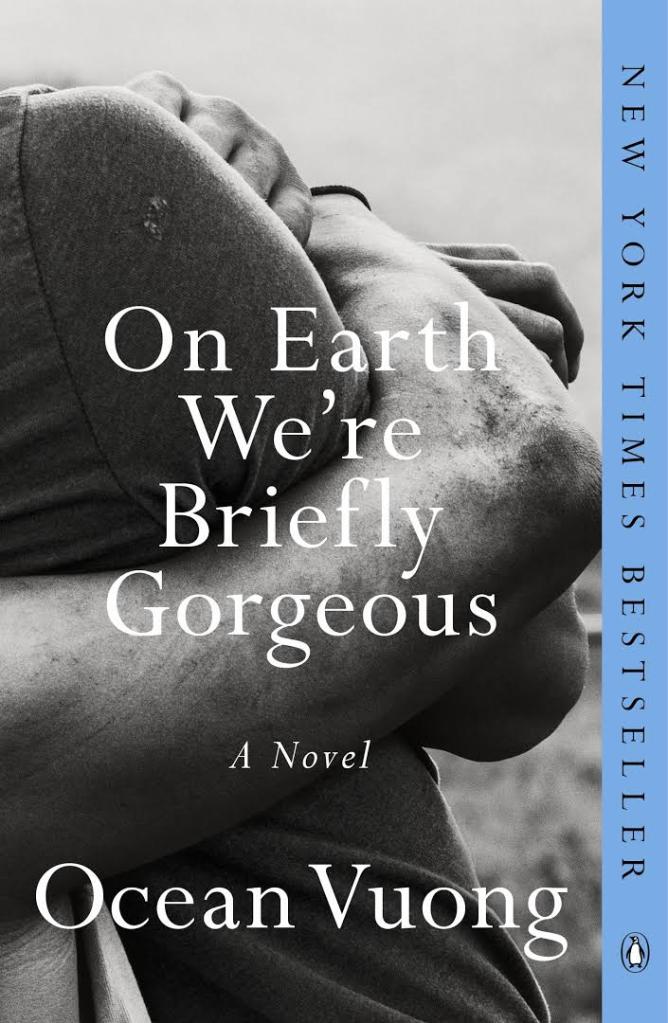
Book 59 was Ocean Vuong’s On Earth We’re Briefly Gorgeous. What a beautiful and tough book. This is what I wrote on FB about it:
– oh my – there is something about books written by poets – you are reading along and then there is a turn of phrase, a play of language, that punches you in the gut…this is a first novel about a Vietnamese refugee boy growing up in Hartford with his mom and grandma…it is about being an immigrant, about being traumatized by war, about being gay, about the opioid crisis, about toxic masculinity, about cruelty and beauty…I had to take a break between part 2 and 3 to read some Phryne Fisher because it was interfering with my sleep but is really worth reading
Since the term started and we started having in person services again (that are once again suspended) I haven’t had a lot of time or concentration for reading. I’ve been devouring Anne Hillerman’s Navajo series and loving them and Kerry Greenwood’s Phryne Fisher series, so fun. Non-fiction though has been tougher.
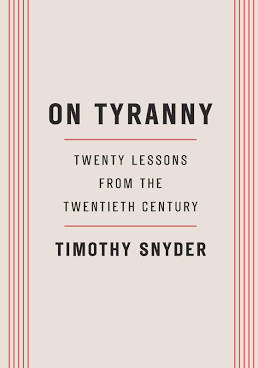
I did however read a book written in small but meaty bits: Timothy Snyder’s On Tyranny: Twenty Lessons from the Twentieth Century. It’s hard not to feel like this is a time when tyranny and autocracy threaten. Snyder, who is a historian focussing on the period of Stalin and Hitler in Europe wrote this small book to try to help people interpret the times we are living in.
Some of the lessons focus on what we would think of as aspects of political life: don’t obey in advance, believe in truth, remember professional ethics… Others are things we might be less inclined to see as political: establish a private life, make eye contact and small talk, contribute to good causes…
I want to read it again – I’ve become more alert to certain things happening since reading it but suspect there is more I could be paying attention to.
A few weeks ago I took a week for study leave and sat in my back yard reading novels and memoirs by people of colour. It was a fascinating week that stretched me. Only one was a book from my shelf – I went to Chapters, pulled up their list of black and indigenous writers and pulled four that interested me. So the legalist in me thinks they shouldn’t count towards my 60 but God willing I’m going to pass that goal soon anyway and I still have 11 months until I turn 60. It’s hard to go a day without a rationalization.
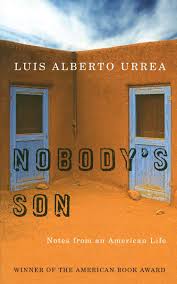
Urrea’s book was already on my shelf. I had picked it up after reading an interview with him a year or so ago. His father was Mexican general and his mother a WASP from an establishment family on Staten Island. This is a memoir that gives glimpses into his childhood, his parents’ volatile marriage, and the tensions in his identity as neither truly Mexican or American. It’s a really powerful, often very moving book. After marrying his parents end up living a much more financially constrained life and it gives some interesting glimpses into the intersections of ethnic and class identity. It also gives some disturbing glimpses into the impact of a toxic masculinity that tried to ‘toughen’ him up as a boy. Now I want to read more of Urrea’s poetry and fiction. He’s a beautiful writer.
Frying Plantain is a first novel by Zalika Reid-Benta set in Toronto . The protagonist has been born in Canada to a mother who had come from Jamaica. She is treated often in school as not really Canadian but her friends who were born in Jamaica don’t consider her truly Jamaican either. So she too is caught between two identities. Her mom is a single mom with a difficult relationship with her own mother. They often need to turn to the grandmother for help because of economic struggles but that help always comes with complicated obligations.
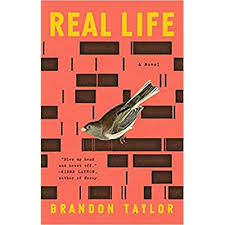
I love campus novels and this one is a great contribution to the genre. Brandon Taylor draws on his own experience as a queer black student in the midwest to write this novel about a queer black grad student from Alabama who has moved north to an unnamed university to do his research in biology. There he discovers that he doesn’t really have a place among the other grad students who along with the profs subject him to a multitude of micro aggressions. As I read it I kept thinking about what Kendi says about how calling these things micro aggressions fails to capture how soul destroying these acts are. There is even a scene where a white woman weaponizes his status as a black man to cover up her own screw up. Much of the book is really disturbing.
I hadn’t heard of this novel or writer until I found it on the list of indigenous books at Chapters but wanted to read it as soon as I heard it was set on the Peguis reserve in Manitoba and in Winnipeg. I don’t know this reserve but I know some of the area spending my summers growing up on Lake Winnipeg. And when he writes about Winnipeg I can see the places he’s describing. The novel moves back and forth in time and place from Jonny’s childhood on the reserve and his life in Winnipeg. He’s two-spirited and the novel describes scenes of violence at the hands of men who want to ‘toughen’ him up similar to those Urrea describes. The life he describes on the reserve is a complicated mix of trauma, abuse, addiction, but also love, generosity, good humour, and resiliency. One week in my reading group we had a long discussion about the ways in which groups get labeled as traumatized people – a point Kendi wants to resist – and I thought about that a lot reading Whitehead’s novel. I find myself thinking about this novel a lot and have since discovered I’m slow to this party as many of my friends love his work already.
My favourite read of the week though was We Have Always Been Here by Samra Habib. I basically read it in one sitting because I couldn’t put it down. This is a memoir by a writer who came to Canada as a refugee with her family when she was in elementary school. They are part of a small sect who are persecuted by the Pakistan government and fled the threat of violence. Her marriage was arranged by her mother when she was 13, she married at 16, and was divorced at 18. She married again only to divorce him when she realized she was queer. There is so much in her book about the experience of an immigrant family, discrimination against people of colour and muslims, and the tensions in her own family over the role of women and sexuality. I found the book so engrossing and thought she addresses some of the issues of sexuality and gender really well that were the weakest in Kendi’s book. It is good to read them together.
I really valued reading these books and have another pile of novels and memoirs to continue reading writers of colour. A friend of mine has made a commitment to read books by women and people of colour for a year – each month she’s focussing on a different scholar – and won’t post any writing on facebook by white men for the same year. I’m curious to see what she learns by doing this. I know that this opened me up to a bunch of experience that isn’t mine and I enjoyed it even as I was challenged by it. Often when white folk post that they are going to do this it sounds like a penance. Maybe that’s part of the problem with some folk – we don’t like stepping out of our comfort zone much. But this is a happy quest for me and one I’d recommend highly!
This is a little different – I’ve been reading Ibram Kendi’s How to be an Anti-racist with a group from the university and my sermon today incorporates some of my thoughts about this incredible book so I’m posting the sermon.
A reading from Paul’s Letter to the Romans chapter 12, verses 1-8
I appeal to you therefore, brothers and sisters, by the mercies of God, to present your bodies as a living sacrifice, holy and acceptable to God, which is your spiritual worship. Do not be conformed to this world, but be transformed by the renewing of your minds, so that you may discern what is the will of God—what is good and acceptable and perfect.
For by the grace given to me I say to everyone among you not to think of yourself more highly than you ought to think, but to think with sober judgment, each according to the measure of faith that God has assigned. For as in one body we have many members, and not all the members have the same function, so we, who are many, are one body in Christ, and individually we are members one of another. We have gifts that differ according to the grace given to us: prophecy, in proportion to faith; ministry, in ministering; the teacher, in teaching; the exhorter, in exhortation; the giver, in generosity; the leader, in diligence; the compassionate, in cheerfulness.
The word of the Lord.
I was confirmed 39 years ago on August 15th in the Roman Catholic parish of St. Ignatius in Winnipeg. As was the catholic custom I took the name of a saint at confirmation, St. Francis. I remember telling Sr. Betty, a nun who worked in the parish, that I wanted to be a saint and St. Francis was my model. Now she thought I was pretty presumptuous until she realized I didn’t mean I wanted to be famous and attract followers like St. Francis. I just wanted to follow Jesus like St. Francis did. He loved the poor, and animals, and worked for peace. That was an example I wanted to follow.
Many years later I visited Assisi and saw his robes. He took his vow of poverty seriously and they were pretty awful, rough, patched, miserable looking. The irony of the church building a huge, gorgeous, cathedral to remember a priest who lived off of charity, never carrying money, really struck me. But it also struck me how far I live from the example of Francis. I’m very torn between the love of his example and the love of beautiful cathedrals.
But though I’m very aware of how far I am from the example of Francis that desire to be a saint, to follow Jesus has never left me. This passage from Romans is often read for confirmations and it always tugs me back to those days when I was first a Christian and really wanted to be a saint.
“Do not be conformed to this world, but be transformed by the renewing of your minds…..” What does it mean not to be conformed to the world? What does it mean to live in such a way that our minds are renewed that we might understand the will of God?
This is one of the main questions Paul is trying to answer in his letters. He’s trying to teach the early Christians how to be followers of Jesus, how to deal with the issues that have come up in the community. What do you do when there is a lot of fighting within the community? what do you do when rich Christians are having parties and getting drunk instead of sharing a common table with poor Christians? what do you do when some Christians are eating food that has been offered to the gods and other Christians are horrified?
Some of the specifics may change but I’m always amazed at how human nature hasn’t changed and the issues are similar to issues we deal with. One of the basic metaphors that grounds his discussion of how we might be saints is that we are all members of one body. In this context he uses the image to make the argument that whatever our individual gifts we are all needed for the life of the community. Each contributes to the life of the body in their own unique and distinctive way.
We are members of a body. That is we are organically connected to each other, part of a bigger whole, needing each other for our very survival and flourishing.
The power of that image hit me in a particular way this week when my university reading group wound up the book we’ve been reading all summer. We’ve been reading Ibram Kendi’s book How to be an Anti-racist and it has been mind blowing. The Lethbridge Public library is starting a study of it now too if you are interested. It’s been #1 on all the best seller lists and it deserves it.
Kendi spends the book looking at the dynamics of racism and arguing that you can’t just be “not a racist,” you need to be an anti-racist. You need to be committed to undoing the racist policies and ideas that oppress people. And his main argument is that the ideas develop to justify the policies because the policies benefit some people and those people operate out of self-interest. Of course the ideas then feed the willingness to create racist policies so it becomes a vicious circle.
One of the things I liked most about the book is that he shares his own journey with racism and not just as its victim. He talks about the ways in which everyone can hold racist ideas, even those who are hurt by them. And he describes the process of the transforming of his mind.
Finally in the last few chapters he relates how his wife, mother, and then he himself were all diagnosed with cancer. His wife and mother recovered following hard treatment for breast cancer while he, at the age of 37 was diagnosed with stage 4 metastatic colon cancer. The odds for him were terrible but two years post surgery he appears to have beaten the odds.
The experience of being treated for cancer, however, made him realize the power of something a speaker had said in a talk once, that racism was a cancer. He came to realize the power of that metaphor, that it means you can’t just treat symptoms, that you need to take radical action to attack the tumour itself, that you have to be willing to endure pain and suffering to come out on the other side healthy. To use Paul’s metaphor of the body, it isn’t enough to recognize that there is racism in our society. If we are all part of one body then the cancer of racism affects us all. And that means that as a community we have to be willing to do the very hard and painful work of rooting it out.
As we talked about that work of rooting out racism our group talked about how hard it is. We talked about the kinds of costs people have had to pay to effect change. I could have pointed to the example of Christians who paid huge social and financial costs to fight slavery or to the example of those who died in the civil rights movement trying to register people to vote. We could look to the amazing example of John Lewis who was beaten and arrested multiple times, nearly killed, and yet he persisted. As my friend said as we talked about it, “it’s asking a lot.”
It is asking a lot. Just think of what we were asked at our baptism and confirmation though. And we ask ourselves these same questions every Easter as well.
Will you continue in the apostles’ teaching and fellowship, in the breaking of bread, and in the prayers?
Will you persevere in resisting evil and, whenever you fall into sin, repent and return to the Lord?
Will you proclaim by word and example the good news of God in Christ?
Will you seek and serve Christ in all persons, loving your neighbour as yourself?
Will you strive for justice and peace among all people, and respect the dignity of every human being?
Will you strive to safeguard the integrity of God’s creation, and respect, sustain and renew the life of the Earth?
And each time we respond, “I will, with God’s help.”
Notice, we commit ourselves to living a healthy life as a body, as the Christian body, as the human body, as the created body. And each time we also recognize that we do this with the help of God, not by our own strength.
And there are suggestions in the questions and in Paul’s writings about how we do this. We gather with the community to learn and pray. We find ways to care for our neighbours. We work for justice, we become anti-racists as one example. We care for creation and work to undo the damage we’ve done to it.
Kendi’s book has emphasized for me some of the practices that Christians have followed for 2000 years. He examines his life and confesses his failings. He has friends who challenge him and who support him. He studies and shares what he learns.
We can do this too. We can reflect on our lives and confess the places where we aren’t following Jesus. We can spend time with people who challenge us to be better, to do better, and who support us in our efforts to be saints. We can commit to study, to learning more about the health and sickness of our collective body so that we understand better how to treat the cancers that threaten us. And we can do this all because God is our help.
It isn’t a good holiday if you don’t read a pile of murder mysteries so in the midst of my memoirs I read three by some favourite authors: Ann Cleeves, Janet Evanovich, and Jonathan Kellerman…some ridiculousness sandwiched between two serious mysteries.
I really enjoy Ann Cleeves’ mysteries because her detectives are very human. This one was from her Vera Stanhope series which I particularly like (love the tv version too – although watching it again after reading this you realize how much gets cut out to fit an episode). Vera doesn’t always treat her team nicely but there is a kindness in her as well.
Janet Evanovich’s Stephanie Plum series is just a lot of silliness. They are outrageous and the characters are pretty much one dimensional and stereotypes. But they make me laugh and I like the people even if they aren’t very deep. This one was very good and a great break from covid.
Kellerman’s are always pretty dark and often involve serial killers. This one was no exception. But his characters are interesting and more complex than Evanovich’s and the relationship between Alex Delaware and his best friend Milo Sturgis is very well written. This one was the best one in a while.
Well I took a week of holidays and read a pile of memoir type books (with a couple of murder mysteries tossed in but I’ll talk about them next). I’ve always enjoyed reading autobiographies and biographies. For some reason the other day I started thinking back about 50 years to the bios I read as a kid. I have no reason why I picked them up but I read bios of old actors I had never seen on the screen and one of the first persons to transition openly in the media. I also read accounts of sailing voyages and Canadian explorers. Lots of them.
The first two I read on my holidays were books related to music, Richard Beck’s Trains, Jesus, and Murder: The Gospel According to Johnny Cash, and Alan Light’s The Holy or the Broken: Leonard Cohen, Jeff Buckley, and the Unlikely Ascent of “Hallelujah.”
I enjoy Beck’s books usually and I mostly liked this one a lot. I learned a lot about Cash’s life and I enjoyed Beck’s analysis of Cash’s theology. There is much that resonates with me and I grew up listening to Cash and the Carter family and all the old gospel hymns. One of the best parts of Beck’s analysis was of the tension between Cash’s patriotism and his understanding of the systemic injustices committed against many groups including indigenous people. One of the worst parts of Beck’s analysis was when he looks at the tension between a systemic analysis of injustice and the personal. It isn’t actually clear that there is a problem in Cash’s view between critiquing the dehumanizing force of the American penal system and the possibility for redemption for the sinner. But Beck levels an attack on Social Justice Warriors who care only for the systemic critique and don’t act in love. Well this may be Beck’s concern but there is no evidence it is Cash’s. Further the term itself is such a weighted term used to dismiss and denigrate people that I almost put the book down at that point. I’m glad I persisted but it is an ugly moment in an otherwise interesting book.
Light’s book was surprisingly engaging. I picked it up initially because I love Cohen’s music and I especially love the song Hallelujah but when I started reading I was sceptical that there was enough in this for a whole book. I was wrong. It was a fascinating history of the song and the various ways it has been interpreted. There are so many possible verses that just an examination of which verses singers choose to sing is illuminating. Now there are a lot of details included about who played back up and who produced recordings etc that meant little to me and I found I skimmed some of that. But the discussion of why the song engages people is fascinating. Essentially he suggests that the tune itself is so emotionally evocative that it has become a lazy way for television or films to get to people emotionally. So the choice of verses ends up seeming less important than the tune itself which produces deep emotions. This leads to an interesting discussion of how it has become a spiritual song for people who aren’t religious. I did want to have a much longer discussion about what those two terms signify and what this says about our cultural time.
The next two books I read were Sister Helen Prejean’s memoir River of Fire and Nancy Kelly’s memoir Souls at Risk. Both spend a lot of time looking at the same period of the fifties and sixties but from very different points of view. This is Prejean’s prequel to her famous book Dead Man Walking which was made into an academy award winning film with Susan Sarandon who played Prejean and Sean Penn playing the death row inmate she journeyed with. This book takes us from Prejean’s days as a student in a Catholic girls school, to the novitiate in religious life, her own work as a teacher, and ultimately to her ministry to men on death row. It’s a fascinating book if you are interested in the impact of Vatican II on North American catholicism and the changes that happened in religious life in those decades. It’s also interesting if you want to watch how one person’s social conscience came alive.
Kelly’s book was fascinating. Her father was a radio producer for people like Eddie Cantor. The family lived in Hollywood and he also had a business organizing concerts. He organized a concert for Pete Seeger in 1960 only to have a huge protest because Seeger refused to sign the loyalty oath. This was still the era of McCarthy and Seeger had been blacklisted for years as a suspected communist. It is never clear why her dad organized the concert in the first place. He had no problem signing the loyalty oath and certainly was no radical. When things blew up though and he was attacked for being a communist sympathizer this conservative veteran became increasingly right wing. Kelly describes her childhood in a home where dad’s behaviour and views became increasingly extreme and the rest of the family learned to be silent. Ironically the Seeger concert began a journey for Kelly to a much more progressive world view.
Kelly’s memoir isn’t linear. She organizes it around the structure of the big house that she grew up in. It means she often returns to the same incidents, the same period of time, circling back from the perspective of another part of their lives. It’s a really interesting idea and at times it revealed new things about significant incidents but there were times I thought it was deja vu all over again. As someone who’s childhood was influenced greatly by Pete Seeger and the politics of the 60s and 70s (I’m about 10 years younger than Kelly) it was a very interesting read though.
I think I have a particular love of memoirs because reading them help me understand my own life. They give me ways of thinking about experience and how I interpret them. They help me make choices about my own journey and where it might go.
Of all the Star Trek series my favourite is STNG. Why is this relevant to a discussion of books you may ask. I’ll get to that. While there were some continuing story arcs in STNG they didn’t dominate the series. Yes, there were some two part episodes. Yes there was that mini-theme of the corruption at the head of the federation. But for the most part you can watch any episode of STNG without feeling like you are dropping into the middle of a story. That’s kind of true for Voyager but that series was just so annoying for so many other reasons we won’t go there. Contrast STNG with DS9 and you see what I mean. You can’t really just dip into DS9. The over arching story of the founders etc is just too important for any episode to really stand alone with a few exceptions. People list their favourite STNG episodes. I don’t see that when people talk about DS9. Having said that when I could binge watch DS9 on Netflix I loved it and I could see why people were fans. It’s a great series when you can watch it all together and get caught up in the grand narratives. But if I just want to veg its STNG for sure.
Okay, so why is this relevant for books. I’m thinking here specifically of murder mysteries. Most, but not all, popular mystery writers write series. They have well known main characters and they may allow those characters to age, to grow, to marry, have children etc over time. They may have more than one series featuring different detectives, like Miss Marple and Hercule Poriot, but they commonly write series. Sure there are great exceptions who I really enjoy – Dick Francis wrote almost all of his novels as stand alones. Grisham does as well. Mostly though I like series. And I like series where there is development in the characters, where one feels like one has become part of a community. Some of my favourites are great at this, Louise Penny, Donna Leon, James Lee Burke. I look forward to new novels – I’ve even been known to note the date of release in my daytimer for the yearly Penny.
The trick in a series though is to write a book that stands alone without the reader needing to know what happened in all the previous books yet advancing the development of the narrative of the detective’s life. When it involves ongoing stories of corruption in the police department or an ongoing crime it becomes tricky. Some of Penny’s almost step over the line where the novel feels like an episode in an ongoing series more than an episode that can be watched on it’s own. See the parallel? It is frustrating to read a novel and get to the end and feel like you need to read the next one to resolve the story only it won’t be released for another year. It’s fine when you discover a new author and can pick up a big bag of the whole series at your local used book store or library (aka the book version of Netflix) but very frustrating if you are reading along a series.
Which brings me to my three latest books. I’ve been enjoying the beautiful evenings sitting in my yard reading the last books in series I really enjoy. Yes, I know that this violates the rule about books on my shelf but grandma’s memoir was 30 years old so I figure I did really well reading an old book and will now indulge with 3 new books.
The first was Peter Robinson’s new book Many Rivers to Cross . I really like DCI Banks and usually really enjoy Robinson’s books but this one frustrated me. He’s introduced an ongoing story about sex traffickers from Eastern Europe that has been running for several books now. In this book Banks is investigating a couple of deaths while alongside that story another character is involved in hunting down traffickers. It isn’t clear if the two narratives are related and I won’t say anything that might ruin the story. It is enough to say that at the end of the book I was really unsatisfied. It felt very much like there really wasn’t enough in this book to be a stand alone book. It lacked a clear focus and the Banks story just didn’t feel meaty enough to be satisfying. It wasn’t a terrible book anymore than individual DS9 episodes are terrible just because they need the bigger story. But it was unsatisfying without a sequel to turn to immediately. And when you have to wait a year for the next episode it is easy to lose interest.
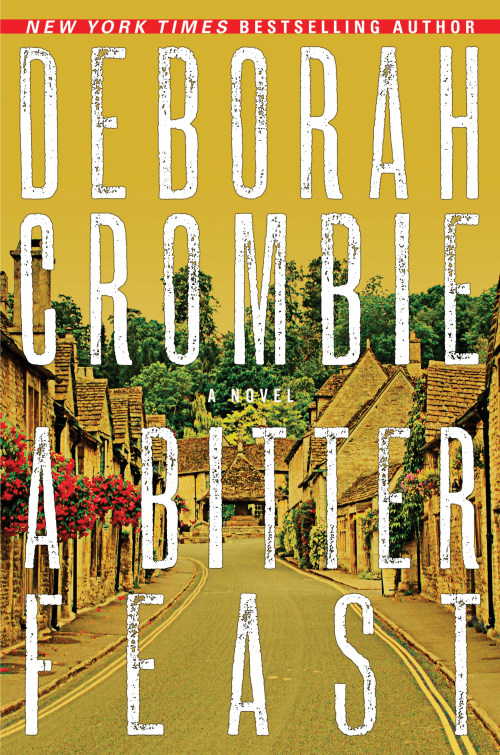
How different were Sara Paretsky’s and Deborah Crombie’s newest novels. Paretsky’s novel Dead Land centres on the story of a homeless woman and ends up being a complicated story of Chilean politics, Chicago corrupt government officials, corrupt lawyers and academics, land activists, and dogs. It was great. Deborah Crombie’s, A Bitter Feast, centres on a holiday weekend in the Cotswolds with several of her main police detectives and is a really enjoyable story about chefs and food and broken relationships. It’s just a great read.
The thing with both the Paretsky and the Crombie mysteries is that interesting things do happen with her characters – they aren’t the same people they were 10 books ago. And I like them well enough that I want to spend time with them. (Contrast this with the latest Patricia Cornwell where I realized about 20% in that I don’t like her characters and I’m sick of reading about their dysfunctional relationships and life was to short to keep reading just because I had already invested a couple of hours into the book). And each book is a satisfying story – complex enough, puzzling enough – to be enjoyable all on it’s own. Now if they could only write them faster!
One day, early in pandemic isolation I heard Madeleine Thien interviewed on the radio. I don’t remember what it was about except that it was something about the relevance of writing in the midst of difficult times. I don’t even remember what she said but I was really taken by her thoughtfulness. I recognized her latest novel having seen it on the bestseller displays at Chapters and downloaded it from the library.
Do Not Say We Have Nothing is a wonderful, complex, moving novel set mostly in China and mostly in the cultural revolution in the ’60s and during the Tiananmen Square protests. It’s hard to say quickly what it is about though because the novel covers so much ground and does not follow a linear narrative structure. It begins and ends from the point of view of a young girl who lives in Vancouver with her mother. Her father has returned to Hong Kong where he has taken his life following which a university student arrives in Vancouver illegally seeking refuge from the violence of the Tiananmen Square protests. Somehow the two girls’ families are connected and after a long telling of the relationships between various individuals and families one comes to understand what the connection is. At the end of the reading though I wanted to read it all over again doing a better job of keeping track of all of the characters. It is a complex novel. There is so much going on it – love, family, politics, language, storytelling, music. Several of the main characters are musicians and Glenn Gould figures significantly. Another is a story teller and discussions of the complexity of Chinese as a written language figure in the stories he writes. I really loved this novel and find it has haunted me since I read it.
After reading Silone’s novel about fascist Italy it was fascinating to read a novel set in Communist China through two particularly tumultuous periods. I learned a lot of more recent Chinese history in the reading and thought a lot about conversations I had with fellow grad students in the late ’80s. I read recent news stories about the 31st anniversary of the protests differently too.
The novel also made me think a lot about my family’s history with China and that got me to read my grandma’s memoir for the first time. I have no idea why I hadn’t read it before. My father’s mother published it not long after the Tiananmen Square protests and came to Hamilton where I was studying and gave a public talk about her work in China.
Grandma’s father was a very young electrical engineer who in the first decade of the 20th century traveled from England to Canton to build an electrical plant. There he met a young English missionary teacher and they married. A year later my grandmother was born. Soon after they moved to Canada because of the political instability of China. My grandmother studied first at Manitoba University and then at UBC where she earned her teaching degree. Afterwards, in the early days of the depression, there were no teaching jobs but she was offered a position teaching in a school in Canton. She and her fiancé took teaching posts and were eventually able to marry there. My uncle and father were born there but the war had broken out and once home for a visit they were unable to return to their positions. My grandparents remained on Vancouver Island, living for a time after the war on a communal farm but living for decades in the house I knew from my earliest memories. In the ’70s as the bamboo curtain began to open a little my grandmother began to take tours to China and she continued into her ’80s.
Besides all the family history I learned reading the book it was fascinating reading her thoughts on Mao and the cultural revolution and to some extent the protests in ’89. I was a teenager when grandma starting going back to China and it was the tail end of the Cultural revolution. All I ever heard from her was glowing reports of how much China had changed since the ’30s. She spoke glowingly of the health care and education that was established and how there was no more of the horrific poverty she witnessed as a young woman. Later I learned a little of the nightmare of the Cultural Revolution when so many university faculty and other educated people were denounced and forced into labour camps and sometimes killed. This figures significantly in Thien’s novel. None of that ever figured in grandma’s accounts. But reading her memoir she does talk about it and she does acknowledge some of the criticisms of Mao (although she tends to lay the blame on his successors). It was interesting to read a more critical response to what she saw after only really ever hearing positives from her. Yet it is also clear that despite whatever reservations she had about the revolution she always contrasted what she saw in modern China with the poverty and corruption she had witnessed as a young teacher.
So for the past few months I’ve been listening to books more than reading them. I could have kept track of the Camillieri mysteries I had listened to but I grew frustrated with their misogyny and finally gave up on them. Then began a much happier streak of listening to the audio versions of Donna Leon’s Brunetti’s series set in Venice. I really enjoy them although I read them already so they don’t count for this exercise. By the way, the German television version of the novels are fun but it is weird reading english subtitles to German speech set in Venice.
As I began to despair that I would ever be able to concentrate on anything longer than a magazine article again I remembered that I had another of Smith’s Botswana novels, number 18 in the series, The House of Unexpected Sisters. In this one the case seems even less important than in earlier books. Instead the heart of the novel is Mma Ramotswe’s searching into the truth of her own family. It is a gentle and kind and lovely story and in a time when much of what is happening is anxiety producing it was good to spend several hours in Precious’ company.
It feels like I’ve not read much of anything in months…probably because I haven’t read much of anything in months. Work continued to be very intense and then we began our covid-19 isolation. You’d think that would give me more time to read but work actually became more intense and frankly I’ve had a hard time focussing on anything much for the past six weeks.
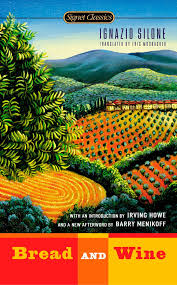
Before covid-19 arrived though I did read a powerful book I’ve thought a lot about since. It is an old novel, Bread and Wine, written by Ignazio Silone and published in 1936. Set in Mussolini’s Italy it tells the story of Pietro Spina who has returned from exile after many years away and who is now being sought by the authorities because of his left-wing politics.
Spina returns to Italy to be reunited with old comrades and to organize an underground resistance to the fascists who have gained control of the government. For much of the story he is hiding out in a village near where he is from in the disguise of a priest. This leads to a fascinating interplay between issues of orthodoxy, praxis, and loyalty in both political movements and the church. Whether in the communist party or the church he fears the way in loyalty to the institution replaces commitment to the original idea.
Reading this novel in concert with much of the news these days was illuminating. It is disturbing to see parallels between the rise of fascism in the 30s and right wing governments today. He gives some real insights into why so much of the gaslighting that is going on is necessary to a certain kind of totalitarian government: “Under every dictatorship,” he said, “one man, one perfectly ordinary little man who goes on thinking with his own brain is a threat to public order. Tons of printed paper spread the slogans of the regime; thousands of loudspeakers, hundreds of thousands of posters and freely distributed leaflets, whole armies of speakers in all the squares and at all the crossroads, thousands of priests in the pulpit repeat these slogans ad nauseam, to the point of collective stupefaction. But it’s sufficient for one little man, just one ordinary, little man to say no, and the whole of that formidable granite order is imperilled.”
As much as it is a political novel, however, it is also a theological novel. Spina’s teacher, a priest who is now out of favour because of his radical views, figures in a significant way through the novel and Spina himself passes as a priest while in hiding. He is scrupulous, despite his loss of faith, not to abuse the trust people place in him because he “is” a priest. This at times because very difficult as people turn to him for prayers and particular to hear their confessions. It is difficult not to see him as in many ways a faithful priest despite his repudiation of the church. In fact his old teacher suggests his life is faithful and when Spina protests he’s lost his faith the old priest responds: “It would not be the first time that the Lord has been forced to hide Himself and make use of an assumed name. As you know He has never attached much importance to the names men have given Him; on the contrary, one of the first of His commandments is not to take His name in vain. And sacred history is full of examples of clandestine living. Have you ever considered the meaning of the flight into Egypt? And later, when He had grown up, did not Jesus several times have to hide himself to escape from the Pharisees?”
After reading this I returned to another novel published just four years after Bread and Wine, Graham Greene’s The Power and the Glory. In that novel, set in Mexico during the revolutionary suppression of the church, the hero is a priest hiding out as a peasant. If I was a student again looking for a paper topic it might be a fascinating exercise to compare these two novels and see what they say both about faith and about totalitarian regimes. Maybe in isolation there will be time for such things.










 60 Before 60