This past weekend I had a long road trip so I downloaded a bunch of audio books from the library to listen to while I drove. I ended up listening to two of Andrea Camilleri’s Inspector Montalbano mysteries, The Pyramid of Mud and The Snack Thief. Last night I read through his wikipedia page trying to figure out which of his many books I had read and what order they were published in since I’ve never read them in order. This morning I woke to discovered he died today.
Camilleri lived to a great age and I’m glad I still have many of his books to read or listen to. They are set in a fictional town in Sicily and follow the career and love life of Montalbano who is often disagreeable and unpleasant but at the same time ethical and persistent. I don’t have affection for him the way I do for Leon’s Brunetti nor do I find Sicily as appealing as Venice. But I do enjoy the books.
Okay…even Anglicans can be flexible. One of the friends who inspired this project suggested that I could change the rules about what counted towards my 60 and I’ve decided that since the spirit of the rules were to stop buying more books without reading the ones I had I would allow library books. Since I read Leon and Kellerman before this liturgical ruling they won’t count. But I just read the new James Lee Burke The New Iberia Blues and it does.
The Robicheaux books take place predominately in New Orleans and there is much discussion of the food, music, history, and culture of the place. Burke’s New Orleans also has a long history of racism, corruption, and exploitation. These are not light reads. Robicheaux has slowly aged through the series and now must be in his sixties. He’s a Vietnam vet along with his best friend Clete and both struggle with the long term affects of abusive childhoods and PTSD. He lives with his daughter, who he and his late wife adopted after her parents die fleeing El Salvador’s civil war. There is nothing really in the books about Trump and his wall but Burke’s sympathies for the marginalized and desperate run through the books.
These are catholic books – not just in the sense that New Orleans is a predominately Roman Catholic state and Robicheaux is a practicing catholic. I’ve read many mysteries where religious props are added but where they really aren’t integral to the story. Much more interesting are the writers who engage ideas, problems, themes, and symbols from a religious tradition as an integral part of the exploration of the murder mystery as mystery in a broader sense. If this interests you I recommend my teacher, Peter Erb’s book Murder, Manners, and Mystery which explores some very interesting intersections of murder mysteries and theological mysteries.
Burke’s books are catholic in the sense that the “whodonit” is only part of the story. Through the investigation we see Robicheaux wrestling with broader, bigger concerns of redemption, forgiveness, evil, and justice. There is also an incredible sense of the thinness between the living and the dead. Robicheaux sees and talks with the dead and their community and the community of the living are closely connected.
So I’m falling really behind on my task of reading 60 before 60. Now I have been reading but I haven’t been reading books off my shelves or my kindle that I had picked up because they looked interesting and then not gotten too. These are the rules and I’m much too much of an Anglican to willy nilly just start including other books that don’t fit the rules. But I have been reading. Good books. That you might enjoy.
For preaching and bible study prep I read Amy Jill Levine’s Entering the Passion of Jesus and her wonderful study of the parables, Short Stories by Jesus. Levine, who is herself Jewish, writes about the ways in which an understanding of 1st century Judaism can illuminate gospel texts and about the ways in which biblical criticism have often reflected anti-semitic tropes. No one is safe from her criticism but she also writes with great humour. I also ordered and have read portions of her commentary on the Gospel of Luke written with Ben Witherington and her annotated New Testament.
I also read the next three mysteries by Ausma Zehanat Khan after finding the first The Unquiet Dead really compelling. The second, The Language of Secrets, is about the radicalization of members of a mosque and was okay but the writing in the third and fourth books was more engaging. Among the Ruins is set in Iran and seemed particularly relevant given current events. A Iranian-Canadian film maker is killed and the detectives are asked to find out why. A Dangerous Crossing which takes place mostly in Greece is about the Syrian refugee crisis and invaded my dreams. This was an especially tough read and while I had a hard time putting it down if you can’t handle descriptions of torture this is not a book you want to start. I’m taking a break before I read the fifth in her series. I really like her character development and the way in which she creates an extended community of friends and family in the same way Elizabeth George or Louise Penny does. But her topics are grim.
Needing a bit of a break I got the latest Jonathan Kellerman, The Wedding Guest, and the latest Donna Leon, Unto Us a Son is Given, out of the library and enjoyed both. Leon is in particularly fine form in her latest and this evening I put supper in the oven to cook and lost myself in her Venice. She always makes me long to be in Venice again despite her descriptions of the smells and the crowds of tourists.
I supposed I would be ahead of the game if I was willing to count these as seven more on my list but this challenge had rules and I don’t intend to start out breaking them. Besides since I started this project I’ve bought far fewer books because I know I’m focusing on my shelves. All in all this is a good thing. So this is just a diversion – now back to the project with Caleb Wilde’s Confessions of a Funeral Director.
On Good Friday, when news of the death of Kyra McKee broke I set aside the book I was reading and turned to a small book of poems by Pádraig Ó Tuama. I had first heard an interview with Pádraig on the podcast On Being and had been incredibly moved by what he had to say about his own story and the story of his work in [the]north[ern][of]ireland with the Corrymeela community. The Corrymeela community works to bring reconciliation and healing between north and south, catholic and protestant.
In the podcast he read this poem and it has echoed in me in so many situations personal and communal where we face pain and injustice and memory.
[the]north[ern][of]ireland
It is both a dignity and
a difficulty
to live between these
names,
perceiving politics
in the syntax of
the state.
And at the end of the day,
the reality is
that whether we
change
or whether we stay
the same
these question will
remain.
Who are we
to be
with one
another?
and
How are we
to be
with one
another?
and
What to do
with all those memories
of all those funerals?
and
What about those present
whose past was blasted
far beyond their future?
I wake.
You wake.
She wakes.
He wakes.
They wake.
We Wake
and take
this troubled beauty forward.
In the last week I have read these poems and meditations slowly and returned to points again and again. His description of the visit of Queen Elizabeth II to Belfast where she would meet Martin McGuinness, the Deputy First Minister of the Northern Ireland Assembly and member of Sinn Fein and shake his hand is very moving:
“Because shared space without human touching doesn’t amount to much.”
You can listen to interviews and see his talks on his website http://www.padraigotuama.com/ and everything is better heard with his lovely gentle voice but I’ll leave you with this: “The Irish word for shadow, scáth, is also the word for shelter. We live in the the shadow and we live in the shelter of each other.”
One of the advantages of having the flu is having the time to read. Look on the bright side..right? So yesterday I decided I wanted to read a murder mystery and took one off the pile, The Unquiet Dead, by Ausma Zehanat Khan. I forget why I picked it up originally but I’m glad I did although it is a very distressing and disturbing read. This is not a cosy village mystery.
The death that sparks the investigation is not particularly disturbing. A man falls to his death on the bluffs of Scarborough on the edge of Toronto and it isn’t clear whether he fell or jumped or was pushed. But there are circumstances that bring it to the attention of the Department of Justice and so Esa Khattak from the Community Policing Unit is asked to take a look. Quickly it becomes clear that this death is related to the war in Bosnia in the early ’90s and war crimes. That part of the story is very disturbing.
Khan’s writing is gripping and the story is intense and I learned a lot about a period of recent history that I knew peripherally but not in any detail. I didn’t learn why people turn on people that they have known their whole lives and rape and murder them but I learned a lot about the fact that they did. At the end I felt wrung out and more alarmed at the examples of right wing extremism we see in Canada and south of the border. I didn’t have any better idea of how to stop it though. But maybe it is enough that the danger seems even more real.
There are now five books with Khattak and Detective Rachel Getty. In some ways the dynamic between the two (and the tone of the book as a whole) reminded me of the relationship between Lynley and Havers in Elizabeth George’s mysteries. I won’t expect a light read but I look forward to reading more of them.
I picked up John Lewis’ story March a while ago and have been meaning to read it every since. It’s a graphic book telling the story of his involvement in the civil rights movement. Volume 1 tells of his growing up and his first actions in non-violent resistance in the lunch counter protests of 1960.
It was through podcasts that I became acquainted with Lewis’ story and ongoing work in the US for racial equality. I commend Krista Tippet’s podcast On Being for her interviews with Lewis and others. https://onbeing.org/programs/beloved-community-john-lewis-2/
It is powerful to read the story of the struggle against racism in the US but today I also watched a video about the amazing Cindy Blackstock and her struggle to see equal treatment of indigenous children by the Canadian government. It is a stark reminder that we need to commit ourselves to the same struggle.
As a part of this challenge I decided that books I had bought for my kindle were “on the shelf” too and so for my second book I read Jenny Erpenbeck’s novel Go, Went, Gone. (I’m still reading March and that will be book 3.) I read a review of it a while ago and downloaded it where it went into kindle limbo. I buy more books than I can possibly read but it is worse when I get them for kindle because if I can’t see it it doesn’t exist (not a theological statement!) and so I tend to forget about these books unlike the ones I tend to look over every day. I have a harder time remembering books I’ve read electronically too and tend to order a hard copy if I really like a book. Kindles I’ve decided are best for traveling and instant gratification and sometimes price for specialty books that I’d have to order from Britain and wait a month or two for.
But I digress. Erpenbeck’s novel tells the story of a recently widowed, recently retired professor of classics living in the suburbs of Berlin, in what would have been East Berlin before 1990. One day while in Alexanderplatz Richard witnesses a group of protesting asylum seekers from Africa and becomes intrigued. After they are moved from the platz to an unused facility he begins to visit and interview them. What follows is an incredibly moving story of his growing attachment to these men, these “dead men on holiday,” and the way in which his life is transformed as they become friends.
Erpenbeck plays constantly with the image of the border as she compares the plight of these men who have fled from violence only to find themselves now in a political fight over their status as refugees. Complex laws and international agreements govern who must accept them but they’ve made border crossings without understanding the implications of where they’ve crossed. But even the borders which had separated them into nations in Africa are arbitrary borders drawn by the same European powers who want nothing to do with the refugees now. “In other words, so-called “asylum fraud” is nothing more than telling a true story in a country where no one’s legally obligated to listen, much less do anything in response.”
But there are other borders too – not just national borders and historical borders but the borders in a human life between when one had a job and family and one became a refugee, or between the living and the dead. Richard’s house is on a lake and at the beginning of the novel we learn that someone has drowned in the lake and his body has not been found. Now no one goes into the water to swim or boat. The surface of the lake becomes a solid border between the living and the dead and foreshadows the separation of the refugees who survive the crossing of the Mediterranean and those who have drowned.
Richard also muses on the thin border between the living and the dead. Erpenbeck connects the German experience of responding to refugees with the treatment of the Jews during the 30s and 40s. After relating the transport of the refugees to new centres Richard thinks that the newspapers will report the high cost of these transports “and this country of bookkeepers will be aghast and blame the objects of the transport for the expense, as used to happen in other periods of German history, with regard to other transports.” In Germany now the border between the living and dead is thin and the murdered dead of the Third Reich still inhabit Germany as ghosts…”Go, went, gone.”
Well I’ve been reading at a decent rate but not blogging obviously so time to start reflecting on what I’m reading.
A few years ago I read James Cone’s book The Cross and the Lynching Tree and it has haunted me ever since. It shows up in my Good Friday sermons and I think every church should play Billie Hollliday’s Strange Fruit that day. One Good Friday I played it as a part of my sermon and the impact was palpable. When I saw that Cone had written a memoir shortly before his death I picked it up wanting to know more about his theology.
Said I Wasn’t Gonna Tell Nobody is an intellectual memoir – there is little in this book about his life outside of his reading, teaching, and writing so if you are hoping for a fuller sense of Cone’s life this won’t do it. But if you want to understand the contribution of one of the most important figures in black theology over the past 60 years this book is invaluable. Essentially Cone relates his own intellectual development by discussing each of his books in turn. He pays close attention to the books he read, the scholars he talked with, and the music he listened to. I think this was the first time that I really thought about the impact music might have on what I’m thinking and writing.
Cone has three significant conversational partners – Martin Luther King, Malcolm X, and James Baldwin. He integrates King’s concern for a proclamation of liberation with Malcolm X’s concern for blackness in his own black liberation theology. Baldwin was a constant literary inspiration:
“Nobody could preach love like Martin; nobody could talk black like Malcolm; and nobody could write with eloquence about love and blackness like Baldwin.” I’ve been stumbling on Baldwin’s work a lot lately and so he’s moved to the top of my 60-before-60 pile.
I was finishing this book just as the news broke of the mosque shootings in Christchurch and I was struck by how little things have changed in 60 years in terms of the “othering” of minorities and the constant threat of violence. Cone began his work with a sense of urgency in the midst of Jim Crow and the civil rights movement and he never lost that sense that this work was critical and urgent.
His own studies had begun with traditional European (white) theology and there is a significant moment early in his teaching career when he realizes that there is nothing in this theology that he thinks is urgent…nothing hangs on it. No doubt people (white theologians) would take issue with him but his observation that Niebuhr could write about justice for decades and never discuss Jim Crow or lynchings is pretty pointed. His observation that there is an underlying assumption that white, european theology is universal in a way that black, or feminist, or queer theology isn’t is I think very important. He was very clear that he was speaking out of a black context in response to black suffering: “We are all particular human beings, finite creatures, and we create our understanding of God out of our experience. Hopefully, our own experience points to the universal, but it is never identical with it. For when we mistake our own talk about God with ultimate reality, we turn it into ideology.”
I particularly enjoyed his chapter on his favourite of his books, The Cross and the Lynching Tree. It was interesting to read that he wrote this in part in response to feminist critique that theologies of the cross were oppressive to women because they encouraged women to submit to their own subjugation through a valorizing of suffering. Cone takes that critique seriously but develops a powerful theology of solidarity drawing on sources where Christ on the cross is seen as one who suffers with blacks as the first lynching victim: “It was their faith in Jesus’s cross, believing that if God was with Jesus, God must be with us, because we are also on the cross.” He argues that it was this vision of Christ’s solidarity in suffering that inspired a brutalized community with a vision of their own dignity and helped keep them sane through the darkness of slavery, segregation, and lynching.
My second read is the graphic book March about John Lewis’ life. I grew up hearing stories of MLK but it has only been in the last few years that I’ve learned more about the broader civil rights movement. There are three books telling the story of his life and work and I had the first on my pile and am almost finished it. I got the 2nd and 3rd out from the library so may need to read them quickly too. But more on that next time.
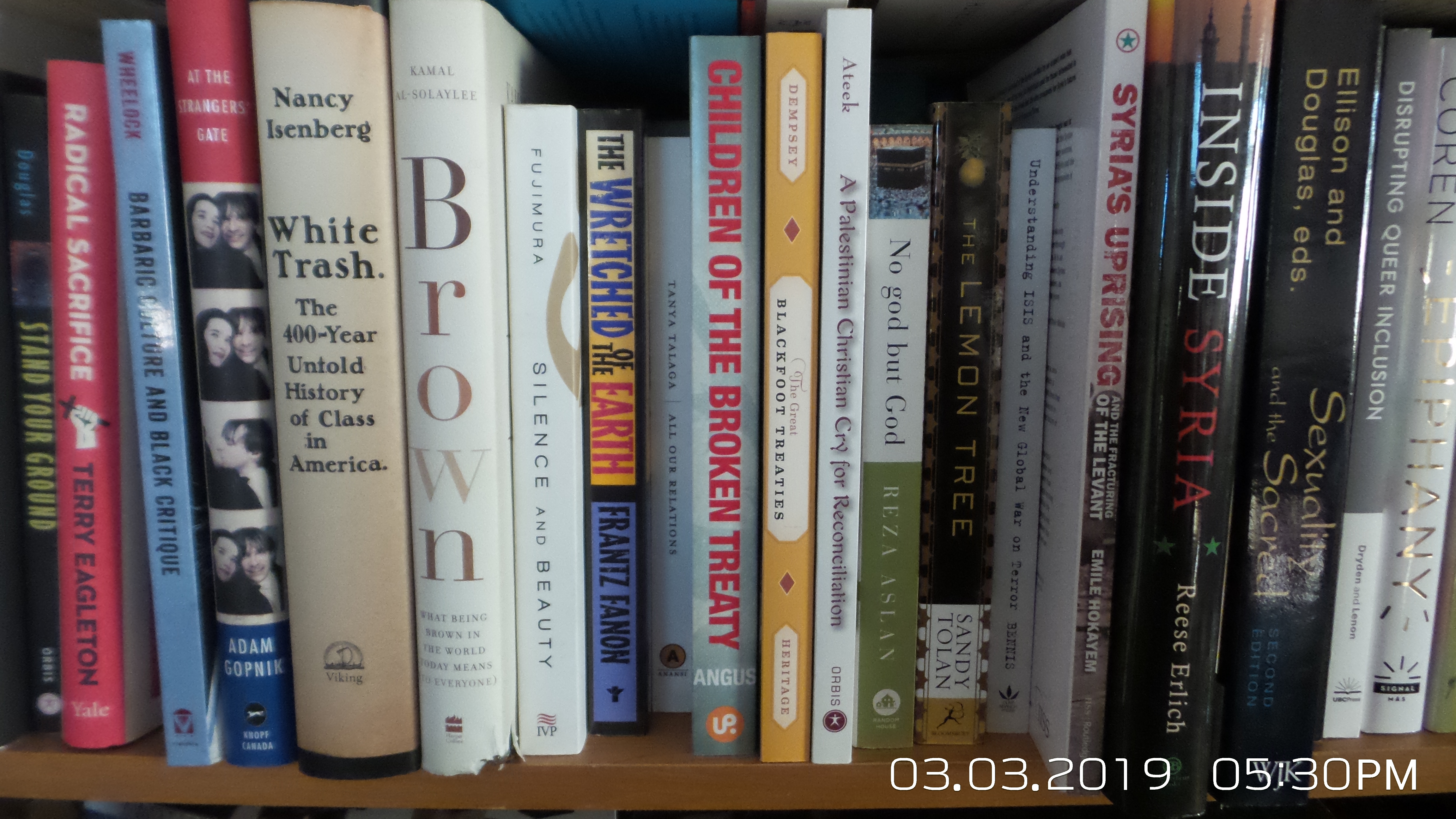
Last year one of my friends did 50 new things before she turned 50. This year another friend is having 50 brunches before she turns 50 (I’ve really enjoyed this challenge!) I realized last night that, God willing, in 30 months I will turn 60, a fact which is rather incomprehensible to me. I have been thinking about what 60 things I wanted to do before 60 and decided that I wanted to read the books that have been accumulating on my “to read” shelf. That’s when I did the math, realized I had 30 months and therefore would need to read roughly two extra books a month (besides murder mysteries and work related stuff) to make it. I decided to keep track of this project and to be able reflect on it I would blog about each book and on the process. So…the journey begins.
The books I have piling up cover a range of things that have interested me lately. No one will be surprised that there is theology and biblical stuff on my shelf. There are also a number of memoirs and some history, sociology, political theory, and books on refugee experience and Islam. There is also a good selection of poetry. I have some fiction I’ve been wanting to read and some studies of zombie literature. It is an eclectic collection. I’ve also been collecting many books on race and indigenous issues. In honour of Black History Month (I know, that was February but it seems wrong that it is the shortest month of the year) I will begin with James H. Cone’s memoir, Said I Wasn’t Gonna Tell Nobody.




 60 Before 60