
It feels like I’ve not read much of anything in months…probably because I haven’t read much of anything in months. Work continued to be very intense and then we began our covid-19 isolation. You’d think that would give me more time to read but work actually became more intense and frankly I’ve had a hard time focussing on anything much for the past six weeks.
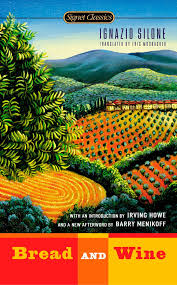
Before covid-19 arrived though I did read a powerful book I’ve thought a lot about since. It is an old novel, Bread and Wine, written by Ignazio Silone and published in 1936. Set in Mussolini’s Italy it tells the story of Pietro Spina who has returned from exile after many years away and who is now being sought by the authorities because of his left-wing politics.
Spina returns to Italy to be reunited with old comrades and to organize an underground resistance to the fascists who have gained control of the government. For much of the story he is hiding out in a village near where he is from in the disguise of a priest. This leads to a fascinating interplay between issues of orthodoxy, praxis, and loyalty in both political movements and the church. Whether in the communist party or the church he fears the way in loyalty to the institution replaces commitment to the original idea.
Reading this novel in concert with much of the news these days was illuminating. It is disturbing to see parallels between the rise of fascism in the 30s and right wing governments today. He gives some real insights into why so much of the gaslighting that is going on is necessary to a certain kind of totalitarian government: “Under every dictatorship,” he said, “one man, one perfectly ordinary little man who goes on thinking with his own brain is a threat to public order. Tons of printed paper spread the slogans of the regime; thousands of loudspeakers, hundreds of thousands of posters and freely distributed leaflets, whole armies of speakers in all the squares and at all the crossroads, thousands of priests in the pulpit repeat these slogans ad nauseam, to the point of collective stupefaction. But it’s sufficient for one little man, just one ordinary, little man to say no, and the whole of that formidable granite order is imperilled.”
As much as it is a political novel, however, it is also a theological novel. Spina’s teacher, a priest who is now out of favour because of his radical views, figures in a significant way through the novel and Spina himself passes as a priest while in hiding. He is scrupulous, despite his loss of faith, not to abuse the trust people place in him because he “is” a priest. This at times because very difficult as people turn to him for prayers and particular to hear their confessions. It is difficult not to see him as in many ways a faithful priest despite his repudiation of the church. In fact his old teacher suggests his life is faithful and when Spina protests he’s lost his faith the old priest responds: “It would not be the first time that the Lord has been forced to hide Himself and make use of an assumed name. As you know He has never attached much importance to the names men have given Him; on the contrary, one of the first of His commandments is not to take His name in vain. And sacred history is full of examples of clandestine living. Have you ever considered the meaning of the flight into Egypt? And later, when He had grown up, did not Jesus several times have to hide himself to escape from the Pharisees?”
After reading this I returned to another novel published just four years after Bread and Wine, Graham Greene’s The Power and the Glory. In that novel, set in Mexico during the revolutionary suppression of the church, the hero is a priest hiding out as a peasant. If I was a student again looking for a paper topic it might be a fascinating exercise to compare these two novels and see what they say both about faith and about totalitarian regimes. Maybe in isolation there will be time for such things.

 60 Before 60