It’s been a while

I’ve gotten out of the habit of reading the books on my shelves instead of constantly buying new ones that pique my interest only to be too busy to read them. This year I did the Goodreads challenge and read 74 books most of which were murder mysteries read before bed. Work was intense and insomnia was my constant companion. But there were more challenging reads mixed in there. 

I read all the long form journalism I can by Rebecca Solnit, Masha Gessen, and Timothy Snyder and loved three of their books I read this year. I read the print version and listened to the audio version of Solnit’s Orwell’s Roses. It is a beautiful wedding of important ideas and gorgeous writing. Masha Gessen’s Surviving Autocracy is disturbingly relevant these days and Timothy Snyder released an audio version of his very important book On Tyranny with additional talks on the war in Ukraine. His course on the history of Ukraine found on the Yale Youtube site is very worth watching in its entirety as well.

Krista Tippet’s podcast On Being introduced me to the wonderful Irish poet and theologian Pádraig Ó Tuama and his new book Poetry Unbound based on his podcast of the same name is delightful. It is another book I have in print and audio format and when I can’t sleep his voice is balm for my soul. Ditto his lovely collection of autobiographical writings In the Shelter which carried me through a stressful time. In recent years I’ve discovered the challenge and the power and the beauty of the writing of James Baldwin and Eddie S. Glaude Jr’s book Begin Again is a wonderful exploration of his work. After reading David Graeber and David Wengrow’s The Dawn of Everything I am challenging myself to read the big pile I have of Graeber books sitting by my desk. 

For fiction the highlights of my ‘serious’ reading were Barbara Kingsolver’s new, much acclaimed, novel Demon Copperhead. I find myself thinking about it all the time. As healthcare in Alberta becomes more and more precarious and the future of oil and gas in question Kingsolver’s novel about the collapse of extraction industries and the developing opioid crisis felt very relevant. Ahmed Saadawi’s Frankenstein in Baghdad also haunts me. It’s a disturbing look at Iraq following the war and the ambiguities of virtue and vice. This novel contributed to some of my problems sleeping for a while. 

As someone who enjoys police procedurals, academic settings, and mysteries set in Britian I enjoyed discovering Elly Griffiths and Kate Ellis this year. I was sad to read the last Peter Robinson mystery and was very glad to read another of Thomas King’s Thumps DreadfulWater books. King is always a fun read and although it’s set across the border it always feels close to home and this time Stand Off even figures in the story.

I’m glad I kept track of the books I read this year. It didn’t feel like I had read much so it was reassuring to have a record of the reading that I did manage to do. I do have a very very big pile of books that wait to be read though so maybe this year I need to go back to my resolution of my original project to only read books from my shelves or the public library. Maybe it is time to start a 65 before 65 project. I’m 32 months away I think so replicating the same pace of 2 a month would do it. Onward forward!

https://www.goodreads.com/user_challenges/38375680

Book Eighteen

I actually read this book last month on James Baldwin’s birthday. Since I watched the documentary I Am Not Your Negro it seems I see references to Baldwin everywhere. I’m not sure if there is a resurgence of interest in him or if it is just that now I’m paying attention. But I have a pile of his books now and started with The Fire Next Time.

It took me a long time to write this because I’ve been thinking a lot about the book and I didn’t want to dash something off. The first part of the book is a letter Baldwin wrote to his nephew about growing up in America as a person of colour. A few summers ago I read Ta-Nehisi Coates book Between the World and Me which is written as a letter to his son and I was disturbed reading Baldwin’s letter by how little things have changed since Baldwin wrote his letter in the early sixties. 

The second part of the book is an essay on race relations in the US and in particular Baldwin’s reflections on religious identity in the context of race relations. He details his own childhood in the church and his reasons for distancing himself it. But he also describes his meeting with Elijah Muhammad and his reasons for not joining the Nation of Islam either. The church failed to speak to the dire conditions of the neighbourhood Baldwin grew up in, promising instead eternal rewards. The Nation of Islam involved a rejection of the white community which Baldwin rejected.

Baldwin writes at length about the ways in which he thinks the circumstances of blacks and whites are tied together and argues that the emancipation of one is tied to the emancipation of the other. Life is ultimately tragic because one day we will all die and we will do anything to hide this fact from ourselves. Baldwin sees in white attitudes towards and treatment of blacks the projection of these fears on others in a futile attempt to see oneself as free from the fact of mortality.

I’ve been thinking a lot lately on the public hostility expressed in social media towards clients of our local Supervised Consumption Site as something of the same. If the racialized “other” is to blame for his or her problems, if they “deserve” punishment, if they are suffering the consequences of their own choices, then I am safe from the threat of the opioid crisis because I am protected by my race, my economic status, my virtue. To which Baldwin responds: whoever debases others is debasing himself. We are all in this together and if we are going to see a better world it is going to be by seeing our redemption as wrapped up in the redemption of all.

Book One

Well I’ve been reading at a decent rate but not blogging obviously so time to start reflecting on what I’m reading.  

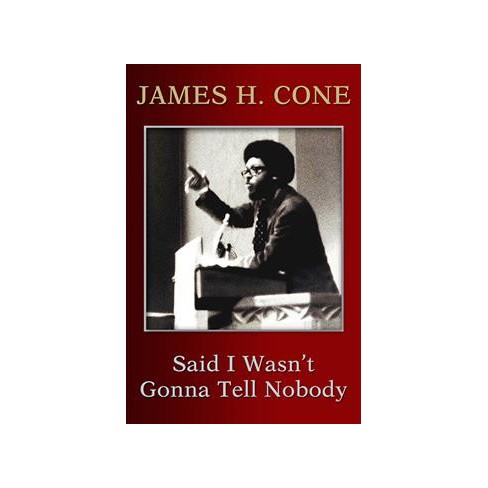
A few years ago I read James Cone’s book The Cross and the Lynching Tree and it has haunted me ever since.  It shows up in my Good Friday sermons and I think every church should play Billie Hollliday’s Strange Fruit that day.  One Good Friday I played it as a part of my sermon and the impact was palpable.  When I saw that Cone had written a memoir shortly before his death I picked it up wanting to know more about his theology.

Said I Wasn’t Gonna Tell Nobody is an intellectual memoir – there is little in this book about his life outside of his reading, teaching, and writing so if you are hoping for a fuller sense of Cone’s life this won’t do it.  But if you want to understand the contribution of one of the most important figures in black theology over the past 60 years this book is invaluable.  Essentially Cone relates his own intellectual development by discussing each of his books in turn.  He pays close attention to the books he read, the scholars he talked with, and the music he listened to.  I think this was the first time that I really thought about the impact music might have on what I’m thinking and writing.

Cone has three significant conversational partners – Martin Luther King, Malcolm X, and James Baldwin.  He integrates King’s concern for a proclamation of liberation with Malcolm X’s concern for blackness in his own black liberation theology.  Baldwin was a constant literary inspiration:

“Nobody could preach love like Martin; nobody could talk black like Malcolm; and nobody could write with eloquence about love and blackness like Baldwin.”  I’ve been stumbling on Baldwin’s work a lot lately and so he’s moved to the top of my 60-before-60 pile.

I was finishing this book just as the news broke of the mosque shootings in Christchurch and I was struck by how little things have changed in 60 years in terms of the “othering” of minorities and the constant threat of violence.  Cone began his work with a sense of urgency in the midst of Jim Crow and the civil rights movement and he never lost that sense that this work was critical and urgent.  

His own studies had begun with traditional European (white) theology and there is a significant moment early in his teaching career when he realizes that there is nothing in this theology that he thinks is urgent…nothing hangs on it.  No doubt people (white theologians) would take issue with him but his observation that Niebuhr could write about justice for decades and never discuss Jim Crow or lynchings is pretty pointed.  His observation that there is an underlying assumption that white, european theology is universal in a way that black, or feminist, or queer theology isn’t is I think very important.  He was very clear that he was speaking out of a black context in response to black suffering:  “We are all particular human beings, finite creatures, and we create our understanding of God out of our experience.  Hopefully, our own experience points to the universal, but it is never identical with it.  For when we mistake our own talk about God with ultimate reality, we turn it into ideology.”

I particularly enjoyed his chapter on his favourite of his books, The Cross and the Lynching Tree.  It was interesting to read that he wrote this in part in response to feminist critique that theologies of the cross were oppressive to women because they encouraged women to submit to their own subjugation through a valorizing of suffering.  Cone takes that critique seriously but develops a powerful theology of solidarity drawing on sources where Christ on the cross is seen as one who suffers with blacks as the first lynching victim:  “It was their faith in Jesus’s cross, believing that if God was with Jesus, God must be with us, because we are also on the cross.”  He argues that it was this vision of Christ’s solidarity in suffering that inspired a brutalized community with a vision of their own dignity and helped keep them sane through the darkness of slavery, segregation, and lynching.

My second read is the graphic book March about John Lewis’ life.  I grew up hearing stories of MLK but it has only been in the last few years that I’ve learned more about the broader civil rights movement.  There are three books telling the story of his life and work and I had the first on my pile and am almost finished it.  I got the 2nd and 3rd out from the library so may need to read them quickly too.  But more on that next time.