It’s been a while

I’ve gotten out of the habit of reading the books on my shelves instead of constantly buying new ones that pique my interest only to be too busy to read them. This year I did the Goodreads challenge and read 74 books most of which were murder mysteries read before bed. Work was intense and insomnia was my constant companion. But there were more challenging reads mixed in there. 

I read all the long form journalism I can by Rebecca Solnit, Masha Gessen, and Timothy Snyder and loved three of their books I read this year. I read the print version and listened to the audio version of Solnit’s Orwell’s Roses. It is a beautiful wedding of important ideas and gorgeous writing. Masha Gessen’s Surviving Autocracy is disturbingly relevant these days and Timothy Snyder released an audio version of his very important book On Tyranny with additional talks on the war in Ukraine. His course on the history of Ukraine found on the Yale Youtube site is very worth watching in its entirety as well.

Krista Tippet’s podcast On Being introduced me to the wonderful Irish poet and theologian Pádraig Ó Tuama and his new book Poetry Unbound based on his podcast of the same name is delightful. It is another book I have in print and audio format and when I can’t sleep his voice is balm for my soul. Ditto his lovely collection of autobiographical writings In the Shelter which carried me through a stressful time. In recent years I’ve discovered the challenge and the power and the beauty of the writing of James Baldwin and Eddie S. Glaude Jr’s book Begin Again is a wonderful exploration of his work. After reading David Graeber and David Wengrow’s The Dawn of Everything I am challenging myself to read the big pile I have of Graeber books sitting by my desk. 

For fiction the highlights of my ‘serious’ reading were Barbara Kingsolver’s new, much acclaimed, novel Demon Copperhead. I find myself thinking about it all the time. As healthcare in Alberta becomes more and more precarious and the future of oil and gas in question Kingsolver’s novel about the collapse of extraction industries and the developing opioid crisis felt very relevant. Ahmed Saadawi’s Frankenstein in Baghdad also haunts me. It’s a disturbing look at Iraq following the war and the ambiguities of virtue and vice. This novel contributed to some of my problems sleeping for a while. 

As someone who enjoys police procedurals, academic settings, and mysteries set in Britian I enjoyed discovering Elly Griffiths and Kate Ellis this year. I was sad to read the last Peter Robinson mystery and was very glad to read another of Thomas King’s Thumps DreadfulWater books. King is always a fun read and although it’s set across the border it always feels close to home and this time Stand Off even figures in the story.

I’m glad I kept track of the books I read this year. It didn’t feel like I had read much so it was reassuring to have a record of the reading that I did manage to do. I do have a very very big pile of books that wait to be read though so maybe this year I need to go back to my resolution of my original project to only read books from my shelves or the public library. Maybe it is time to start a 65 before 65 project. I’m 32 months away I think so replicating the same pace of 2 a month would do it. Onward forward!

https://www.goodreads.com/user_challenges/38375680

Book 85

I found Homeland Elegies by Ayad Akhtar really hard to put down. I read afterwards that it is a mixed memoir/novel and now want to reread it to see what seems like what. It is a really gripping novel about the son of immigrants and his experience of being Muslim in America.

Books 82-84

I’ve read some good memoirs this year too. Steven Heighton’s Reaching Mithymna about his time volunteering on Lesbos with refugees was a good read. Eternity Martis’ book They Said This Would be Fun about her time as a student of colour at Western was a tough read but powerful. The one that has really stuck with me was Jillian Horton’s We Are All Perfectly Fine about burnout among physicians and the systemic problems with medical training and work life.

Books 45, 46, 47, and 48

Well I took a week of holidays and read a pile of memoir type books (with a couple of murder mysteries tossed in but I’ll talk about them next). I’ve always enjoyed reading autobiographies and biographies. For some reason the other day I started thinking back about 50 years to the bios I read as a kid. I have no reason why I picked them up but I read bios of old actors I had never seen on the screen and one of the first persons to transition openly in the media. I also read accounts of sailing voyages and Canadian explorers. Lots of them.

The first two I read on my holidays were books related to music, Richard Beck’s Trains, Jesus, and Murder: The Gospel According to Johnny Cash, and Alan Light’s The Holy or the Broken: Leonard Cohen, Jeff Buckley, and the Unlikely Ascent of “Hallelujah.”

I enjoy Beck’s books usually and I mostly liked this one a lot. I learned a lot about Cash’s life and I enjoyed Beck’s analysis of Cash’s theology. There is much that resonates with me and I grew up listening to Cash and the Carter family and all the old gospel hymns. One of the best parts of Beck’s analysis was of the tension between Cash’s patriotism and his understanding of the systemic injustices committed against many groups including indigenous people. One of the worst parts of Beck’s analysis was when he looks at the tension between a systemic analysis of injustice and the personal. It isn’t actually clear that there is a problem in Cash’s view between critiquing the dehumanizing force of the American penal system and the possibility for redemption for the sinner. But Beck levels an attack on Social Justice Warriors who care only for the systemic critique and don’t act in love. Well this may be Beck’s concern but there is no evidence it is Cash’s. Further the term itself is such a weighted term used to dismiss and denigrate people that I almost put the book down at that point. I’m glad I persisted but it is an ugly moment in an otherwise interesting book.

Light’s book was surprisingly engaging. I picked it up initially because I love Cohen’s music and I especially love the song Hallelujah but when I started reading I was sceptical that there was enough in this for a whole book. I was wrong. It was a fascinating history of the song and the various ways it has been interpreted. There are so many possible verses that just an examination of which verses singers choose to sing is illuminating. Now there are a lot of details included about who played back up and who produced recordings etc that meant little to me and I found I skimmed some of that. But the discussion of why the song engages people is fascinating. Essentially he suggests that the tune itself is so emotionally evocative that it has become a lazy way for television or films to get to people emotionally. So the choice of verses ends up seeming less important than the tune itself which produces deep emotions. This leads to an interesting discussion of how it has become a spiritual song for people who aren’t religious. I did want to have a much longer discussion about what those two terms signify and what this says about our cultural time.

The next two books I read were Sister Helen Prejean’s memoir River of Fire and Nancy Kelly’s memoir Souls at Risk. Both spend a lot of time looking at the same period of the fifties and sixties but from very different points of view. This is Prejean’s prequel to her famous book Dead Man Walking which was made into an academy award winning film with Susan Sarandon who played Prejean and Sean Penn playing the death row inmate she journeyed with. This book takes us from Prejean’s days as a student in a Catholic girls school, to the novitiate in religious life, her own work as a teacher, and ultimately to her ministry to men on death row. It’s a fascinating book if you are interested in the impact of Vatican II on North American catholicism and the changes that happened in religious life in those decades. It’s also interesting if you want to watch how one person’s social conscience came alive.

Kelly’s book was fascinating. Her father was a radio producer for people like Eddie Cantor. The family lived in Hollywood and he also had a business organizing concerts. He organized a concert for Pete Seeger in 1960 only to have a huge protest because Seeger refused to sign the loyalty oath. This was still the era of McCarthy and Seeger had been blacklisted for years as a suspected communist. It is never clear why her dad organized the concert in the first place. He had no problem signing the loyalty oath and certainly was no radical. When things blew up though and he was attacked for being a communist sympathizer this conservative veteran became increasingly right wing. Kelly describes her childhood in a home where dad’s behaviour and views became increasingly extreme and the rest of the family learned to be silent. Ironically the Seeger concert began a journey for Kelly to a much more progressive world view.

Kelly’s memoir isn’t linear. She organizes it around the structure of the big house that she grew up in. It means she often returns to the same incidents, the same period of time, circling back from the perspective of another part of their lives. It’s a really interesting idea and at times it revealed new things about significant incidents but there were times I thought it was deja vu all over again. As someone who’s childhood was influenced greatly by Pete Seeger and the politics of the 60s and 70s (I’m about 10 years younger than Kelly) it was a very interesting read though.

I think I have a particular love of memoirs because reading them help me understand my own life. They give me ways of thinking about experience and how I interpret them. They help me make choices about my own journey and where it might go.

Books 40 and 41

One day, early in pandemic isolation I heard Madeleine Thien interviewed on the radio. I don’t remember what it was about except that it was something about the relevance of writing in the midst of difficult times. I don’t even remember what she said but I was really taken by her thoughtfulness. I recognized her latest novel having seen it on the bestseller displays at Chapters and downloaded it from the library.

Do Not Say We Have Nothing is a wonderful, complex, moving novel set mostly in China and mostly in the cultural revolution in the ’60s and during the Tiananmen Square protests. It’s hard to say quickly what it is about though because the novel covers so much ground and does not follow a linear narrative structure. It begins and ends from the point of view of a young girl who lives in Vancouver with her mother. Her father has returned to Hong Kong where he has taken his life following which a university student arrives in Vancouver illegally seeking refuge from the violence of the Tiananmen Square protests. Somehow the two girls’ families are connected and after a long telling of the relationships between various individuals and families one comes to understand what the connection is. At the end of the reading though I wanted to read it all over again doing a better job of keeping track of all of the characters. It is a complex novel. There is so much going on it – love, family, politics, language, storytelling, music. Several of the main characters are musicians and Glenn Gould figures significantly. Another is a story teller and discussions of the complexity of Chinese as a written language figure in the stories he writes. I really loved this novel and find it has haunted me since I read it.

After reading Silone’s novel about fascist Italy it was fascinating to read a novel set in Communist China through two particularly tumultuous periods. I learned a lot of more recent Chinese history in the reading and thought a lot about conversations I had with fellow grad students in the late ’80s. I read recent news stories about the 31st anniversary of the protests differently too.

The novel also made me think a lot about my family’s history with China and that got me to read my grandma’s memoir for the first time. I have no idea why I hadn’t read it before. My father’s mother published it not long after the Tiananmen Square protests and came to Hamilton where I was studying and gave a public talk about her work in China.

Grandma’s father was a very young electrical engineer who in the first decade of the 20th century traveled from England to Canton to build an electrical plant. There he met a young English missionary teacher and they married. A year later my grandmother was born. Soon after they moved to Canada because of the political instability of China. My grandmother studied first at Manitoba University and then at UBC where she earned her teaching degree. Afterwards, in the early days of the depression, there were no teaching jobs but she was offered a position teaching in a school in Canton. She and her fiancé took teaching posts and were eventually able to marry there. My uncle and father were born there but the war had broken out and once home for a visit they were unable to return to their positions. My grandparents remained on Vancouver Island, living for a time after the war on a communal farm but living for decades in the house I knew from my earliest memories. In the ’70s as the bamboo curtain began to open a little my grandmother began to take tours to China and she continued into her ’80s.

Besides all the family history I learned reading the book it was fascinating reading her thoughts on Mao and the cultural revolution and to some extent the protests in ’89. I was a teenager when grandma starting going back to China and it was the tail end of the Cultural revolution. All I ever heard from her was glowing reports of how much China had changed since the ’30s. She spoke glowingly of the health care and education that was established and how there was no more of the horrific poverty she witnessed as a young woman. Later I learned a little of the nightmare of the Cultural Revolution when so many university faculty and other educated people were denounced and forced into labour camps and sometimes killed. This figures significantly in Thien’s novel. None of that ever figured in grandma’s accounts. But reading her memoir she does talk about it and she does acknowledge some of the criticisms of Mao (although she tends to lay the blame on his successors). It was interesting to read a more critical response to what she saw after only really ever hearing positives from her. Yet it is also clear that despite whatever reservations she had about the revolution she always contrasted what she saw in modern China with the poverty and corruption she had witnessed as a young teacher.

Book 17

So I’m behind on blogging and I’m about to go out of order because I actually read this book yesterday. The joy of holidays is staying up half the night finishing a book because you can. Yesterday I read Shulem Deen’s All Who Go Do Not Return, a memoir of his life as a member of a particularly conservative Hasidic sect in New York. Deen’s community is very insular, he isn’t supposed to read secular books or newspapers, watch tv, or go to films. Schools, jobs, the neighbourhood…all part of the community. Marriages are arranged and the rebbe, the head of the community makes decisions for your life that are not negotiable. One member of the community decides not to invite the rebbe to a significant event and his car is trashed.

Deen begins to secretly read books and go onto the internet, becomes a blogger, begins to read historical criticism of the Bible and ends up not only leaving the community but losing his faith all together. His marriage fails and ultimately he ends up with next to no access to his children. It’s fascinating and horrifying and sad and I couldn’t put it down. In many ways it was like reading Tara Westover’s Educated which I also read in a day. Both of them give an glimpse into an insular religious culture and into the struggles when you’ve been denied a decent education of fitting in outside that culture.

Part of what made me sad was the way in which there was no room in the community to be a little different, to assert any independence, to deviate in anyway from the dictated pattern of life. This was replicated in the way in which there was no room to deviate intellectually either. To ask questions, to read books from outside the tradition, to engage with people outside the community, all these things are prohibited. When he loses his faith it seems inevitable.

When he talks about the questions he has, when he talks about the ideas he is encountering I kept thinking about how I knew about those ideas, I had read some of those same books…why didn’t they shake my faith in the same way. It strikes me that I was fortunate to find myself in a community (in the broadest sense) that allowed for these questions and that allowed me to find my own way of working through questions or not work through them without making me choose between them or the questions. What really struck me was the way in which participation in the community required great intellectual conformance as well as behavioural. I couldn’t do it. And neither could he. But it also struck me as he described his grief at what he had lost, his children being the greatest but not only loss, that those of us in looser communities also don’t experience the intensity of that kind of insular community.

There is a scene in the movie Witness, where Harrison Ford’s character, a police officer hiding from corrupt cops in an Amish community, is helping in a barn building. It is a delightful scene of a community helping out the newly married couple get set up. The next scene shows one of the elders telling the woman Ford has eyes for that people are beginning to talk and if she doesn’t stop it she will be shunned. In ten short minutes you see the price you pay for that kind of tight community.

All communities need to navigate the issue of conformity and diversity somehow and personally I’m not willing to give up ambiguity or my questions even to have a barn built in my backyard. It seems to me to be too high a price to pay.

Book fourteen

In the last 25 years I’ve had 3 bouts with cellulitis. All three necessitated long stints of IV antibiotics which until recently meant day time treatments M-F in outpatients and evening and weekends in Emerg. There would come a point when I wasn’t feeling so terrible anymore and I would start to find the experience fascinating. I know, weird eh? I am still friends with some other patients and with some of the nurses I met during the last two runs. Before renovations which made the ER all white and shiny and much more private it was an amazing place to watch human interactions. I used to know who was on triage when I walked in just from the anxiety levels in the waiting room. There were a couple of nurses who were incredibly skilled at calming people down and even making us laugh in the midst of our suffering. I decided that I should have gone into medical sociology when I did my uni studies as there really is nothing more interesting to study. I could have done my field work in ERs!

One of the things I grew to love about going to the hospital three times a day was all the time I had to read. My fascination with the place also lead to my reading lots of medical memoirs and it is a big field. Brian Goldman’s The Night Shift, Tilda Shalof’s The Making of a Nurse, and Victoria Sweet’s God’s Hotel are my three favourites in that genre. My 14th book in this project is James Maskalyk’s Life on the Ground Floor: Letters from the edge of emergency medicine and it will go on the shelf next to others as a great read. Maskalyk alternates between working in Toronto and Ethiopia and weaves together stories from both with stories of his grandfather who lives in northern Alberta. It’s a very moving book that seemed to me to be a meditation as much on dying as on healing.

I’ve been thinking about this book since I finished it. One of the things I find fascinating about it is that while there are obviously big differences between emergency medicine in Toronto and Addis Ababa what struck me was the similarities. In both situations it is Maskalyk’s connection to patients that is front and centre. And in particular, it is his ability to remain present to his patients even in the presence of suffering and their dying that moved me. He describes the signs of burn out when indifference and anger become the attitude of staff towards patients. It struck me how this parallels in some ways the experience of ministry when clergy begin to feel manipulated, or criticized, or taken for granted and begin to resent the people they are called to serve. But while Maskalyk may say, it is time then to quit, he’s actually very understanding of the struggles to stay healthy in medicine (and I suspect “helping” professionals generally). Certainly there are unique aspects to the kind of intensity he experiences in his work and particular issues in working shift work (he talks about the dangers of self-medication to get to sleep and to wake up) but there is a lot of wisdom in his observations for anyone struggling with compassion fatigue or secondary trauma.

At one point Maskalyk talks about how in addition to the worries docs start taking the numbness home too. He says that joy starts to seem like it is for fools because in the end all of us will die. This made me think of Caleb Wilde’s comments about being risk averse and overly protective of children because of the awareness of how badly things can go. A friend of mine, a funeral director, asked me once, when I was really cautious about walking down a dock to get into a boat, if I had always been this scared of the water. No I said, I grew up on boats and around water. I’d become this way after 20 years of doing funerals. Working with post-secondary students too many of the services I’ve done have followed tragic deaths. It is easy to become obsessed with the fragility of human life and to begin to resent people who seem blissfully unaware of how quickly their lives can change.

There is a line in the film version of Shadowlands in which a student says to C.S.Lewis, something to the effect of “I read to know I’m not alone.” I felt often reading this book, despite living and working in very different circumstances, a sense of recognition. In an incredible poem entitled “fuck you ee cummings”, Ron Currie writes:

when you’re a writer people sometimes ask
why you decided to be a writer
insofar as there’s any answer
the thing i’ve settled on is that
writing is an act of faith
the faith that you and i love the same things
fear the same things
grieve the same things
no matter that i am a man and you are a woman
or that i am white and you are latino
or that i am american and you are afghani 
faith, in short, that love and fear and grief are the same thing everywhere
and the rest is just details
and that if i write about the things i love and fear and grieve,
you will see yourself in me
and vice versa
and having looked in the mirror
and seen ourselves rendered strange yet recognizable
we will be less lonely and afraid and angry
and less inclined to want to kill each other
and less likely to dismiss each other’s suffering
maybe.

Maskalyk is a really good writer.

Book 12

A few days ago Macleans released an article on the working class in Canada focussing on the work of Wolfgang Lehmann, a sociology professor at Western. Lehmann studies the experience of working class students in university and this was the focus of the article. https://www.macleans.ca/society/what-does-it-mean-to-be-working-class-in-canada/ It is a fascinating article and echoed many of the things a friend has said to me about going to university after growing up in a mill town.

In each of the last three summers I’ve read a memoir by someone who grew up poor and disadvantaged and yet achieved stellar educations. Two summers ago it was J. D. Vance’s Hillbilly Elegy. Last summer it was Tara Westover’s Educated. Vance’s book details how he grew up in poverty in Ohio but after serving in the marines was able to attend Yale Law school. He describes the obstacles that stood in his way, both in getting to university and to fitting in once he got there. It was a bestseller but was also criticized by some for underplaying the systemic barriers at play for many poor students, particularly those of colour. Westover recounts her childhood in a fundamentalist mormon family where the children didn’t go to school or access medical treatment. But she loved learning and is able through a remarkable effort to teach herself enough to get admitted to BYU. Ultimately she is able to study in Cambridge. This is also a gripping book and became a bestseller. Both writers offer insight into the challenges they faced of not “belonging” at university but also becoming alienated from their own families and communities because they have gone.

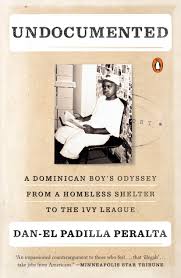
After reading a review this winter I picked up another memoir in this vein, Undocumented, by Dan-el Padilla Peralta. Peralta, who now is a classics professor at Princeton, came from the Dominican Republic as a boy with his parents to live in New York. His father returned after the birth of his brother but his mother decided to stay with her two sons although only her youngest had papers once her visa expired. Undocumented is Peralta’s story of growing up in living in constant fear that their lack of papers would be discovered and they would be deported. He loved books and learning and was fortunate to meet people who opened doors for him – a private school education that led to Princeton and then Oxford. Ultimately he was given papers and allowed to return to the US where he did a doctorate at Stanford. In many ways it is an exceptional story and he addresses that clearly in the last chapter. He now advocates for immigration reform and for other undocumented students and he knows his story is not typical. He attributes much of it to luck and refuses to see his own story as a “rags to riches” story of personal accomplishment. The system is broken and has gotten even worse since 2015 when the book was published.

I remember reading John Osborn’s classic account of Harvard law school, Paper Chase, and being inspired to study study study. Peralta’s book inspired in me some of that same love of study and desire to immerse myself in reading. It is difficult to explain to those who see reading as a task or chore how it can be a delight and magical as it clearly is for him. Reading opens up a world to Peralta as they are living in a shelter. It is fascinating to read how he discovers classics and to read his reflections on why it is largely a white discipline.

A big part of what is both painful and engrossing about the book though is his account of what it is like living in multiple worlds and not feeling at home in any. The energy that goes into keeping secret his status is exhausting. And then there is the discussion over what it means to be black on a predominately white campus and whether he has an obligation to speak out about his immigration status. It’s a powerful read.

One last thought: Peralta is very clear that he was fortunate to receive support and love from teachers and others along the way. His story is a great example of how people can make a huge difference in the life of a child by showing up, by challenging them, and by loving them.