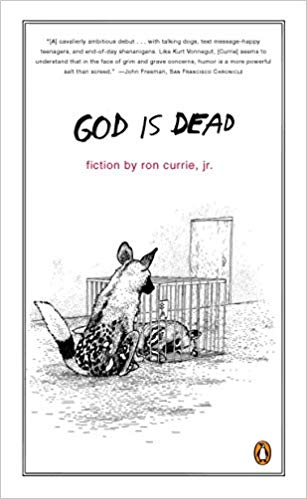
So in my post on book 14 I quoted a poem by Ron Currie, Jr. In another place in the poem he talks about a book he wrote in which he writes about a Sudanese refugee camp. I check out the book, it’s call God is Dead, and I’m intrigued. The public library has it, I start reading it at about seven last night and I read until I finish it.
It reads like a bunch of interconnected short stories all responding to the premise of the first chapter, that God was incarnate in a refugee girl who is killed in a camp and whose body is then eaten by dogs. People realize that she was God when the dogs gain human awareness and are able to communicate telepathically with humans. One of the dogs relates that story in a later chapter.
It is such a strange book that I really wish I had someone else who had read it so I could talk about it with them. In part the book is saying things about the problem of evil – God repents for not preventing suffering and the description of suffering in the refugee camp is tough reading. In fact, there are many places where this is tough reading. Murder, suicide, war, abused dogs. I need to think about it more. Or convince a friend to read it so we can talk.
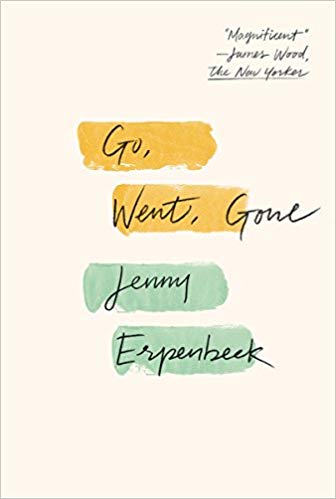
As a part of this challenge I decided that books I had bought for my kindle were “on the shelf” too and so for my second book I read Jenny Erpenbeck’s novel Go, Went, Gone. (I’m still reading March and that will be book 3.) I read a review of it a while ago and downloaded it where it went into kindle limbo. I buy more books than I can possibly read but it is worse when I get them for kindle because if I can’t see it it doesn’t exist (not a theological statement!) and so I tend to forget about these books unlike the ones I tend to look over every day. I have a harder time remembering books I’ve read electronically too and tend to order a hard copy if I really like a book. Kindles I’ve decided are best for traveling and instant gratification and sometimes price for specialty books that I’d have to order from Britain and wait a month or two for.
But I digress. Erpenbeck’s novel tells the story of a recently widowed, recently retired professor of classics living in the suburbs of Berlin, in what would have been East Berlin before 1990. One day while in Alexanderplatz Richard witnesses a group of protesting asylum seekers from Africa and becomes intrigued. After they are moved from the platz to an unused facility he begins to visit and interview them. What follows is an incredibly moving story of his growing attachment to these men, these “dead men on holiday,” and the way in which his life is transformed as they become friends.
Erpenbeck plays constantly with the image of the border as she compares the plight of these men who have fled from violence only to find themselves now in a political fight over their status as refugees. Complex laws and international agreements govern who must accept them but they’ve made border crossings without understanding the implications of where they’ve crossed. But even the borders which had separated them into nations in Africa are arbitrary borders drawn by the same European powers who want nothing to do with the refugees now. “In other words, so-called “asylum fraud” is nothing more than telling a true story in a country where no one’s legally obligated to listen, much less do anything in response.”
But there are other borders too – not just national borders and historical borders but the borders in a human life between when one had a job and family and one became a refugee, or between the living and the dead. Richard’s house is on a lake and at the beginning of the novel we learn that someone has drowned in the lake and his body has not been found. Now no one goes into the water to swim or boat. The surface of the lake becomes a solid border between the living and the dead and foreshadows the separation of the refugees who survive the crossing of the Mediterranean and those who have drowned.
Richard also muses on the thin border between the living and the dead. Erpenbeck connects the German experience of responding to refugees with the treatment of the Jews during the 30s and 40s. After relating the transport of the refugees to new centres Richard thinks that the newspapers will report the high cost of these transports “and this country of bookkeepers will be aghast and blame the objects of the transport for the expense, as used to happen in other periods of German history, with regard to other transports.” In Germany now the border between the living and dead is thin and the murdered dead of the Third Reich still inhabit Germany as ghosts…”Go, went, gone.”

 60 Before 60