So a funny thing happened on the way to 60. For reasons I don’t understand I didn’t want to get to book 60 so far ahead of my birthday. And a new bookstore opened in town and I completely abandoned the whole, don’t buy books, read what you have premise. When the bookstore owner tells you that she is worried she’s enabling unhealthy buying you know you have really abandoned the premise.
Now the truth is that I have read lots that I got out from the library and some that I bought with gift cards (two of my gross rationalizations from earlier) and I’ve read a couple from my shelves. So I’ve chosen two books that meet the criteria for books 59 and 60 and then will post the list of everything else I’ve read. And since I’m now on holidays I expect to be reading a lot more in the next few weeks. Joy!
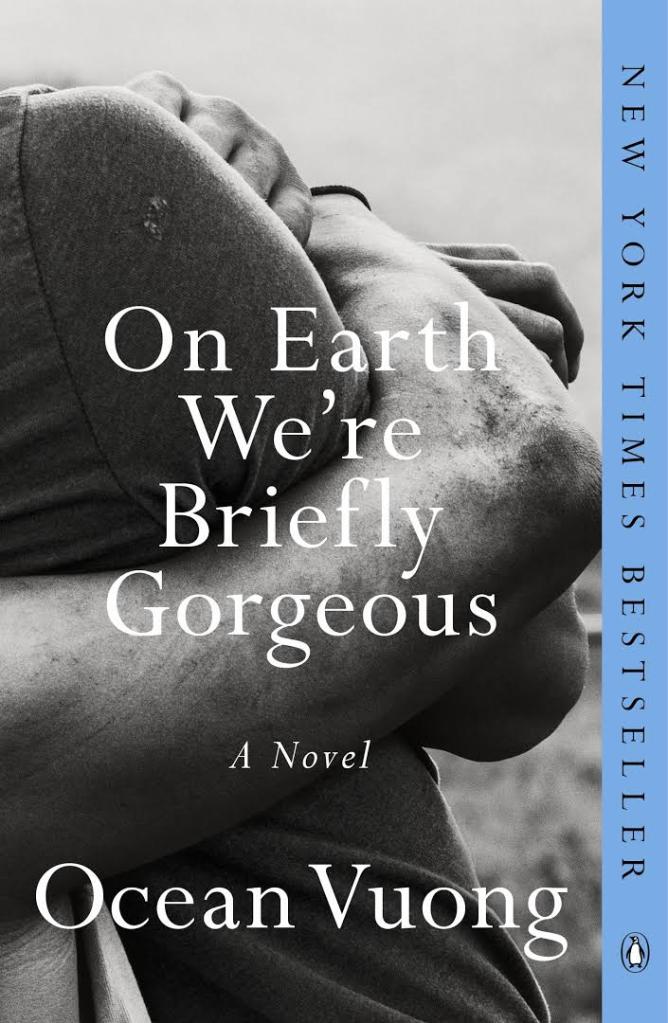
Book 59 was Ocean Vuong’s On Earth We’re Briefly Gorgeous. What a beautiful and tough book. This is what I wrote on FB about it:
– oh my – there is something about books written by poets – you are reading along and then there is a turn of phrase, a play of language, that punches you in the gut…this is a first novel about a Vietnamese refugee boy growing up in Hartford with his mom and grandma…it is about being an immigrant, about being traumatized by war, about being gay, about the opioid crisis, about toxic masculinity, about cruelty and beauty…I had to take a break between part 2 and 3 to read some Phryne Fisher because it was interfering with my sleep but is really worth reading
This is a little different – I’ve been reading Ibram Kendi’s How to be an Anti-racist with a group from the university and my sermon today incorporates some of my thoughts about this incredible book so I’m posting the sermon.
A reading from Paul’s Letter to the Romans chapter 12, verses 1-8
I appeal to you therefore, brothers and sisters, by the mercies of God, to present your bodies as a living sacrifice, holy and acceptable to God, which is your spiritual worship. Do not be conformed to this world, but be transformed by the renewing of your minds, so that you may discern what is the will of God—what is good and acceptable and perfect.
For by the grace given to me I say to everyone among you not to think of yourself more highly than you ought to think, but to think with sober judgment, each according to the measure of faith that God has assigned. For as in one body we have many members, and not all the members have the same function, so we, who are many, are one body in Christ, and individually we are members one of another. We have gifts that differ according to the grace given to us: prophecy, in proportion to faith; ministry, in ministering; the teacher, in teaching; the exhorter, in exhortation; the giver, in generosity; the leader, in diligence; the compassionate, in cheerfulness.
The word of the Lord.
I was confirmed 39 years ago on August 15th in the Roman Catholic parish of St. Ignatius in Winnipeg. As was the catholic custom I took the name of a saint at confirmation, St. Francis. I remember telling Sr. Betty, a nun who worked in the parish, that I wanted to be a saint and St. Francis was my model. Now she thought I was pretty presumptuous until she realized I didn’t mean I wanted to be famous and attract followers like St. Francis. I just wanted to follow Jesus like St. Francis did. He loved the poor, and animals, and worked for peace. That was an example I wanted to follow.
Many years later I visited Assisi and saw his robes. He took his vow of poverty seriously and they were pretty awful, rough, patched, miserable looking. The irony of the church building a huge, gorgeous, cathedral to remember a priest who lived off of charity, never carrying money, really struck me. But it also struck me how far I live from the example of Francis. I’m very torn between the love of his example and the love of beautiful cathedrals.
But though I’m very aware of how far I am from the example of Francis that desire to be a saint, to follow Jesus has never left me. This passage from Romans is often read for confirmations and it always tugs me back to those days when I was first a Christian and really wanted to be a saint.
“Do not be conformed to this world, but be transformed by the renewing of your minds…..” What does it mean not to be conformed to the world? What does it mean to live in such a way that our minds are renewed that we might understand the will of God?
This is one of the main questions Paul is trying to answer in his letters. He’s trying to teach the early Christians how to be followers of Jesus, how to deal with the issues that have come up in the community. What do you do when there is a lot of fighting within the community? what do you do when rich Christians are having parties and getting drunk instead of sharing a common table with poor Christians? what do you do when some Christians are eating food that has been offered to the gods and other Christians are horrified?
Some of the specifics may change but I’m always amazed at how human nature hasn’t changed and the issues are similar to issues we deal with. One of the basic metaphors that grounds his discussion of how we might be saints is that we are all members of one body. In this context he uses the image to make the argument that whatever our individual gifts we are all needed for the life of the community. Each contributes to the life of the body in their own unique and distinctive way.
We are members of a body. That is we are organically connected to each other, part of a bigger whole, needing each other for our very survival and flourishing.
The power of that image hit me in a particular way this week when my university reading group wound up the book we’ve been reading all summer. We’ve been reading Ibram Kendi’s book How to be an Anti-racist and it has been mind blowing. The Lethbridge Public library is starting a study of it now too if you are interested. It’s been #1 on all the best seller lists and it deserves it.
Kendi spends the book looking at the dynamics of racism and arguing that you can’t just be “not a racist,” you need to be an anti-racist. You need to be committed to undoing the racist policies and ideas that oppress people. And his main argument is that the ideas develop to justify the policies because the policies benefit some people and those people operate out of self-interest. Of course the ideas then feed the willingness to create racist policies so it becomes a vicious circle.
One of the things I liked most about the book is that he shares his own journey with racism and not just as its victim. He talks about the ways in which everyone can hold racist ideas, even those who are hurt by them. And he describes the process of the transforming of his mind.
Finally in the last few chapters he relates how his wife, mother, and then he himself were all diagnosed with cancer. His wife and mother recovered following hard treatment for breast cancer while he, at the age of 37 was diagnosed with stage 4 metastatic colon cancer. The odds for him were terrible but two years post surgery he appears to have beaten the odds.
The experience of being treated for cancer, however, made him realize the power of something a speaker had said in a talk once, that racism was a cancer. He came to realize the power of that metaphor, that it means you can’t just treat symptoms, that you need to take radical action to attack the tumour itself, that you have to be willing to endure pain and suffering to come out on the other side healthy. To use Paul’s metaphor of the body, it isn’t enough to recognize that there is racism in our society. If we are all part of one body then the cancer of racism affects us all. And that means that as a community we have to be willing to do the very hard and painful work of rooting it out.
As we talked about that work of rooting out racism our group talked about how hard it is. We talked about the kinds of costs people have had to pay to effect change. I could have pointed to the example of Christians who paid huge social and financial costs to fight slavery or to the example of those who died in the civil rights movement trying to register people to vote. We could look to the amazing example of John Lewis who was beaten and arrested multiple times, nearly killed, and yet he persisted. As my friend said as we talked about it, “it’s asking a lot.”
It is asking a lot. Just think of what we were asked at our baptism and confirmation though. And we ask ourselves these same questions every Easter as well.
Will you continue in the apostles’ teaching and fellowship, in the breaking of bread, and in the prayers?
Will you persevere in resisting evil and, whenever you fall into sin, repent and return to the Lord?
Will you proclaim by word and example the good news of God in Christ?
Will you seek and serve Christ in all persons, loving your neighbour as yourself?
Will you strive for justice and peace among all people, and respect the dignity of every human being?
Will you strive to safeguard the integrity of God’s creation, and respect, sustain and renew the life of the Earth?
And each time we respond, “I will, with God’s help.”
Notice, we commit ourselves to living a healthy life as a body, as the Christian body, as the human body, as the created body. And each time we also recognize that we do this with the help of God, not by our own strength.
And there are suggestions in the questions and in Paul’s writings about how we do this. We gather with the community to learn and pray. We find ways to care for our neighbours. We work for justice, we become anti-racists as one example. We care for creation and work to undo the damage we’ve done to it.
Kendi’s book has emphasized for me some of the practices that Christians have followed for 2000 years. He examines his life and confesses his failings. He has friends who challenge him and who support him. He studies and shares what he learns.
We can do this too. We can reflect on our lives and confess the places where we aren’t following Jesus. We can spend time with people who challenge us to be better, to do better, and who support us in our efforts to be saints. We can commit to study, to learning more about the health and sickness of our collective body so that we understand better how to treat the cancers that threaten us. And we can do this all because God is our help.
One of the advantages of having the flu is having the time to read. Look on the bright side..right? So yesterday I decided I wanted to read a murder mystery and took one off the pile, The Unquiet Dead, by Ausma Zehanat Khan. I forget why I picked it up originally but I’m glad I did although it is a very distressing and disturbing read. This is not a cosy village mystery.
The death that sparks the investigation is not particularly disturbing. A man falls to his death on the bluffs of Scarborough on the edge of Toronto and it isn’t clear whether he fell or jumped or was pushed. But there are circumstances that bring it to the attention of the Department of Justice and so Esa Khattak from the Community Policing Unit is asked to take a look. Quickly it becomes clear that this death is related to the war in Bosnia in the early ’90s and war crimes. That part of the story is very disturbing.
Khan’s writing is gripping and the story is intense and I learned a lot about a period of recent history that I knew peripherally but not in any detail. I didn’t learn why people turn on people that they have known their whole lives and rape and murder them but I learned a lot about the fact that they did. At the end I felt wrung out and more alarmed at the examples of right wing extremism we see in Canada and south of the border. I didn’t have any better idea of how to stop it though. But maybe it is enough that the danger seems even more real.
There are now five books with Khattak and Detective Rachel Getty. In some ways the dynamic between the two (and the tone of the book as a whole) reminded me of the relationship between Lynley and Havers in Elizabeth George’s mysteries. I won’t expect a light read but I look forward to reading more of them.
I picked up John Lewis’ story March a while ago and have been meaning to read it every since. It’s a graphic book telling the story of his involvement in the civil rights movement. Volume 1 tells of his growing up and his first actions in non-violent resistance in the lunch counter protests of 1960.
It was through podcasts that I became acquainted with Lewis’ story and ongoing work in the US for racial equality. I commend Krista Tippet’s podcast On Being for her interviews with Lewis and others. https://onbeing.org/programs/beloved-community-john-lewis-2/
It is powerful to read the story of the struggle against racism in the US but today I also watched a video about the amazing Cindy Blackstock and her struggle to see equal treatment of indigenous children by the Canadian government. It is a stark reminder that we need to commit ourselves to the same struggle.



 60 Before 60