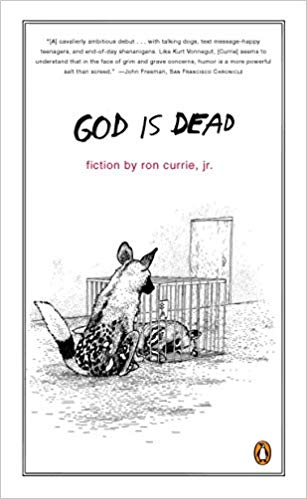
So in my post on book 14 I quoted a poem by Ron Currie, Jr. In another place in the poem he talks about a book he wrote in which he writes about a Sudanese refugee camp. I check out the book, it’s call God is Dead, and I’m intrigued. The public library has it, I start reading it at about seven last night and I read until I finish it.
It reads like a bunch of interconnected short stories all responding to the premise of the first chapter, that God was incarnate in a refugee girl who is killed in a camp and whose body is then eaten by dogs. People realize that she was God when the dogs gain human awareness and are able to communicate telepathically with humans. One of the dogs relates that story in a later chapter.
It is such a strange book that I really wish I had someone else who had read it so I could talk about it with them. In part the book is saying things about the problem of evil – God repents for not preventing suffering and the description of suffering in the refugee camp is tough reading. In fact, there are many places where this is tough reading. Murder, suicide, war, abused dogs. I need to think about it more. Or convince a friend to read it so we can talk.
In the last 25 years I’ve had 3 bouts with cellulitis. All three necessitated long stints of IV antibiotics which until recently meant day time treatments M-F in outpatients and evening and weekends in Emerg. There would come a point when I wasn’t feeling so terrible anymore and I would start to find the experience fascinating. I know, weird eh? I am still friends with some other patients and with some of the nurses I met during the last two runs. Before renovations which made the ER all white and shiny and much more private it was an amazing place to watch human interactions. I used to know who was on triage when I walked in just from the anxiety levels in the waiting room. There were a couple of nurses who were incredibly skilled at calming people down and even making us laugh in the midst of our suffering. I decided that I should have gone into medical sociology when I did my uni studies as there really is nothing more interesting to study. I could have done my field work in ERs!
One of the things I grew to love about going to the hospital three times a day was all the time I had to read. My fascination with the place also lead to my reading lots of medical memoirs and it is a big field. Brian Goldman’s The Night Shift, Tilda Shalof’s The Making of a Nurse, and Victoria Sweet’s God’s Hotel are my three favourites in that genre. My 14th book in this project is James Maskalyk’s Life on the Ground Floor: Letters from the edge of emergency medicine and it will go on the shelf next to others as a great read. Maskalyk alternates between working in Toronto and Ethiopia and weaves together stories from both with stories of his grandfather who lives in northern Alberta. It’s a very moving book that seemed to me to be a meditation as much on dying as on healing.
I’ve been thinking about this book since I finished it. One of the things I find fascinating about it is that while there are obviously big differences between emergency medicine in Toronto and Addis Ababa what struck me was the similarities. In both situations it is Maskalyk’s connection to patients that is front and centre. And in particular, it is his ability to remain present to his patients even in the presence of suffering and their dying that moved me. He describes the signs of burn out when indifference and anger become the attitude of staff towards patients. It struck me how this parallels in some ways the experience of ministry when clergy begin to feel manipulated, or criticized, or taken for granted and begin to resent the people they are called to serve. But while Maskalyk may say, it is time then to quit, he’s actually very understanding of the struggles to stay healthy in medicine (and I suspect “helping” professionals generally). Certainly there are unique aspects to the kind of intensity he experiences in his work and particular issues in working shift work (he talks about the dangers of self-medication to get to sleep and to wake up) but there is a lot of wisdom in his observations for anyone struggling with compassion fatigue or secondary trauma.
At one point Maskalyk talks about how in addition to the worries docs start taking the numbness home too. He says that joy starts to seem like it is for fools because in the end all of us will die. This made me think of Caleb Wilde’s comments about being risk averse and overly protective of children because of the awareness of how badly things can go. A friend of mine, a funeral director, asked me once, when I was really cautious about walking down a dock to get into a boat, if I had always been this scared of the water. No I said, I grew up on boats and around water. I’d become this way after 20 years of doing funerals. Working with post-secondary students too many of the services I’ve done have followed tragic deaths. It is easy to become obsessed with the fragility of human life and to begin to resent people who seem blissfully unaware of how quickly their lives can change.
There is a line in the film version of Shadowlands in which a student says to C.S.Lewis, something to the effect of “I read to know I’m not alone.” I felt often reading this book, despite living and working in very different circumstances, a sense of recognition. In an incredible poem entitled “fuck you ee cummings”, Ron Currie writes:
when you’re a writer people sometimes ask why you decided to be a writer insofar as there’s any answer the thing i’ve settled on is that writing is an act of faith the faith that you and i love the same things fear the same things grieve the same things no matter that i am a man and you are a woman or that i am white and you are latino or that i am american and you are afghani faith, in short, that love and fear and grief are the same thing everywhere and the rest is just details and that if i write about the things i love and fear and grieve, you will see yourself in me and vice versa and having looked in the mirror and seen ourselves rendered strange yet recognizable we will be less lonely and afraid and angry and less inclined to want to kill each other and less likely to dismiss each other’s suffering maybe.
Well I’ve been reading at a decent rate but not blogging obviously so time to start reflecting on what I’m reading.
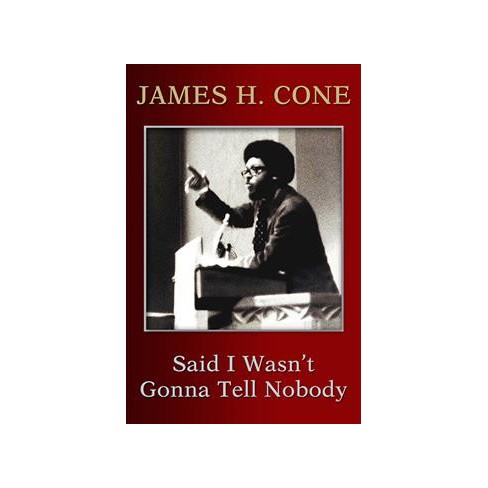
A few years ago I read James Cone’s book The Cross and the Lynching Tree and it has haunted me ever since. It shows up in my Good Friday sermons and I think every church should play Billie Hollliday’s Strange Fruit that day. One Good Friday I played it as a part of my sermon and the impact was palpable. When I saw that Cone had written a memoir shortly before his death I picked it up wanting to know more about his theology.
Said I Wasn’t Gonna Tell Nobody is an intellectual memoir – there is little in this book about his life outside of his reading, teaching, and writing so if you are hoping for a fuller sense of Cone’s life this won’t do it. But if you want to understand the contribution of one of the most important figures in black theology over the past 60 years this book is invaluable. Essentially Cone relates his own intellectual development by discussing each of his books in turn. He pays close attention to the books he read, the scholars he talked with, and the music he listened to. I think this was the first time that I really thought about the impact music might have on what I’m thinking and writing.
Cone has three significant conversational partners – Martin Luther King, Malcolm X, and James Baldwin. He integrates King’s concern for a proclamation of liberation with Malcolm X’s concern for blackness in his own black liberation theology. Baldwin was a constant literary inspiration:
“Nobody could preach love like Martin; nobody could talk black like Malcolm; and nobody could write with eloquence about love and blackness like Baldwin.” I’ve been stumbling on Baldwin’s work a lot lately and so he’s moved to the top of my 60-before-60 pile.
I was finishing this book just as the news broke of the mosque shootings in Christchurch and I was struck by how little things have changed in 60 years in terms of the “othering” of minorities and the constant threat of violence. Cone began his work with a sense of urgency in the midst of Jim Crow and the civil rights movement and he never lost that sense that this work was critical and urgent.
His own studies had begun with traditional European (white) theology and there is a significant moment early in his teaching career when he realizes that there is nothing in this theology that he thinks is urgent…nothing hangs on it. No doubt people (white theologians) would take issue with him but his observation that Niebuhr could write about justice for decades and never discuss Jim Crow or lynchings is pretty pointed. His observation that there is an underlying assumption that white, european theology is universal in a way that black, or feminist, or queer theology isn’t is I think very important. He was very clear that he was speaking out of a black context in response to black suffering: “We are all particular human beings, finite creatures, and we create our understanding of God out of our experience. Hopefully, our own experience points to the universal, but it is never identical with it. For when we mistake our own talk about God with ultimate reality, we turn it into ideology.”
I particularly enjoyed his chapter on his favourite of his books, The Cross and the Lynching Tree. It was interesting to read that he wrote this in part in response to feminist critique that theologies of the cross were oppressive to women because they encouraged women to submit to their own subjugation through a valorizing of suffering. Cone takes that critique seriously but develops a powerful theology of solidarity drawing on sources where Christ on the cross is seen as one who suffers with blacks as the first lynching victim: “It was their faith in Jesus’s cross, believing that if God was with Jesus, God must be with us, because we are also on the cross.” He argues that it was this vision of Christ’s solidarity in suffering that inspired a brutalized community with a vision of their own dignity and helped keep them sane through the darkness of slavery, segregation, and lynching.
My second read is the graphic book March about John Lewis’ life. I grew up hearing stories of MLK but it has only been in the last few years that I’ve learned more about the broader civil rights movement. There are three books telling the story of his life and work and I had the first on my pile and am almost finished it. I got the 2nd and 3rd out from the library so may need to read them quickly too. But more on that next time.

 60 Before 60